
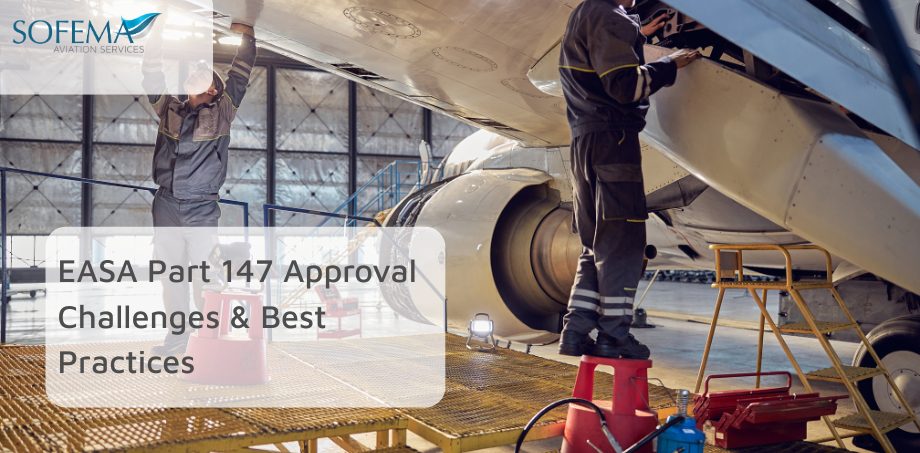
Sofema Aviation Services considers issues, challenges, and best practices related to the EASA Part 147 Approval landscape, moving beyond basic regulatory definitions to practical operational realities. It is designed for professionals looking to establish, manage, or audit a Maintenance Training Organisation (MTO).
Executive Summary: The Role of Part 147
Unlike a standard school, a Part 147 MTO is a critical link in the airworthiness chain-its output is not just a “graduate” but a legal privilege to release aircraft to service.
The core tension in Part 147 operations is balancing commercial pressure (fast, efficient courses) with regulatory rigidity (strict attendance, exam security, and practical competency).
Critical Issues & Challenges
These are the most frequent friction points where organisations fail or struggle during audits.
The “Instructor Paradox”
- The Issue: Finding staff who are both technical experts and competent teachers is difficult.
- The Challenge: A brilliant B1/B2 licensed engineer may struggle to deliver a coherent lecture or manage a classroom. Conversely, a professional teacher may lack the “street credibility” or deep system knowledge required for Type Training.
- Regulatory Trap: Auditors frequently find that instructors have expired “continuing airworthiness” experience (must be 35 hours every 2 years) or lack formal instructional techniques training.
Practical Training Logistics (The “Phantom Aircraft”)
- The Issue: Type training requires access to a real aircraft.
- The Challenge: Airlines are reluctant to pull revenue-generating aircraft out of service for training. MTOs often struggle to secure the specific aircraft variant for the required duration (10 days for Type Training practicals is common).
- Regulatory Trap: “Simulated” practicals are often overused. While simulators are allowed for system diagnostics, you cannot simulate the removal or installation of a physical component. Auditors will cross-reference the MTO’s schedule with the aircraft’s flight logs; if the plane was flying while the students were supposedly checking the landing gear, it is a major Level 1 finding.
Examination Integrity & Question Bank Management
- The Issue: The question bank (MTOE 2.13) is the MTO’s most sensitive asset.
- The Challenge: Developing thousands of Multi-Choice Questions (MCQs) that are technically accurate, linguistically neutral, and secure is resource-intensive. Students often share “past papers,” compromising the bank.
- Regulatory Trap:
>> Static Banks: Using the same exam version for years.
>> Poor analysis: Failing to track question performance (e.g., if 100% of students fail Question #42, is the question wrong?).
>> Security: Leaving exam papers on desks or in unsecured digital folders.
The MTOE (Maintenance Training Organisation Exposition)
- The Issue: The MTOE is a living manual, not a one-time document.
- The Challenge: Keeping the MTOE aligned with reality. Often, procedures written 5 years ago do not reflect current digital workflows (e.g., using iPads for attendance instead of paper).
- Regulatory Trap: A common finding is “Procedure not followed,” which means the MTOE says X, but the staff does Y.
Best Practices for Compliance & Efficiency
High-performing MTOs adopt these strategies to stay compliant and competitive.
Robust Training Needs Analysis (TNA) – Do not view TNA as a paperwork exercise. It is the blueprint for your course duration and content.
- Best Practice: When introducing a new Type Course, use the TNA to map the aircraft’s complexity to the course’s duration. If a new B787 has complex fiber-optic networks, the TNA must show added hours for that ATA chapter compared to a B737 NG course.
- Value: This justifies your course length to the regulator and ensures students actually pass.
“Train-the-Trainer” Ecosystem – Invest heavily in your instructors.
- Best Practice: Implement an internal mentorship program where junior instructors “shadow” senior engineers on live aircraft maintenance checks to keep their licenses current.
- Value: This solves the “recency of experience” compliance requirement and keeps training realistic.
Digital Practical Logbooks – Move away from paper logbooks for practical training.
- Best Practice: Use tablet-based apps where the instructor must digitally “sign off” a task with a timestamp and potentially a photo of the completed task.
- Value: This creates an audit-proof trail. It eliminates the “Friday afternoon sign-off” phenomenon where students bulk-sign tasks they didn’t do.
Part 145 Integration (The Partnership) – Most MTOs (Part 147) rely on a Maintenance Org (Part 145) for aircraft access.
- Best Practice: Establish a Service Level Agreement (SLA) that guarantees access to specific aircraft tails or components (e.g., spare engines in the shop).
- Crucial Step: The Part 147 Quality Manager must audit the Part 145 facility independently. You cannot assume their approval covers your needs.
Next Steps
Sofema Aviation Services and Sofema Online provide classroom, webinar and online regulatory and compliant EASA Part 147 & EASA Part 66 training. Please see the websites or email [email protected]
Tags:
EASA Part 147, AviationSafetyManagement, SofemaAviationServices, AircraftMaintenanceTraining, EASAPart66, MaintenanceTrainingOrganisation, AviationTrainingCompliance, AviationQualityAssurance, AviationRegulatoryTraining, MTOCompliance