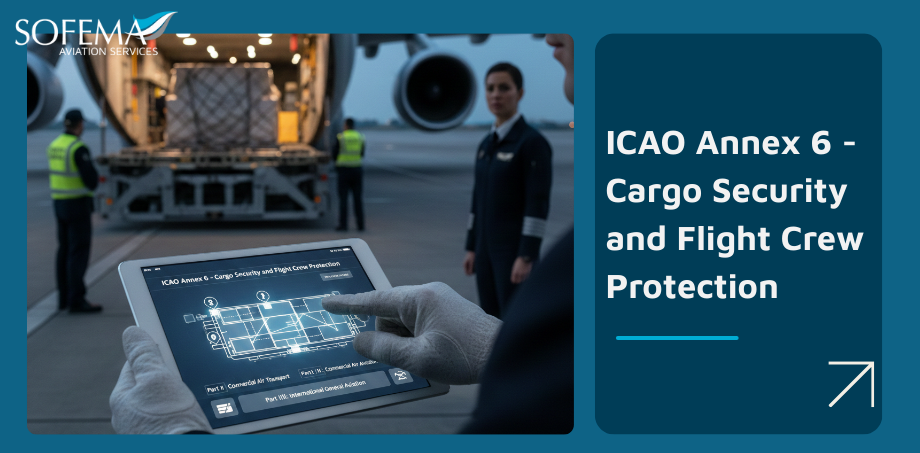
Sofema Aviation Services (SAS) examines the differences between ICAO and EASA regarding Cargo Security & Flight Crew Protection.
Introduction
ICAO Annex 6 (Operation of Aircraft) sets global Standards, and Recommended Practices (SARPs), EASA translates these into binding European regulations, primarily through Regulation (EU) No 965/2012 (Air Operations).
- Two primary pillars of these security provisions are Cargo Security and Flight Crew Protection.
Cargo Security
Cargo security focuses on preventing the introduction of prohibited items (explosives, weapons, or dangerous goods) into the aircraft.
ICAO Annex 6 Requirements
Annex 6, Part I, Chapter 13 requires operators to establish procedures to ensure that:
- Security Controls: All cargo and mail are subject to appropriate security controls (screening or supply chain security) before loading.
- Risk Assessment: Operators must conduct a safety risk assessment for the transport of items in the cargo compartment, with particular focus on fire risks and the nature of the cargo (e.g., lithium batteries).
- Chain of Custody: Cargo must be protected from unauthorized interference from the point of screening until the aircraft departs.
EASA Implementation (Part-CAT & Part-ORO)
EASA follows a “layered” approach where security is shared between the airport, the shipper, and the operator:
- CAT.GEN.MPA.160: Governs the carriage of weapons and munitions of war, requiring specific reporting and secure storage in a place inaccessible to passengers.
- Dangerous Goods (SPA.DG): While Annex 18 covers DG specifically, Annex 6/EASA link safety and security here. EASA requires operators to have a management system to ensure that “hidden” dangerous goods (which could be used as weapons) are not loaded as general cargo.
- Known Consignor/Regulated Agent: Under EU security regulations, cargo is only accepted from “trusted” entities or after 100% screening.
Flight Crew Protection
Flight crew protection is centered on preventing unauthorized access to the flight deck (the “citadel concept”)
ICAO Annex 6 Requirements
Annex 6 mandates specific physical and procedural barriers:
- Lockable Doors: All passenger-carrying aircraft must have a flight crew compartment door.
- Reinforced Doors: For aircraft with a Maximum Certificated Take-off Mass (MCTM) exceeding 45,500 kg or a passenger capacity exceeding 60, the door must be reinforced to resist penetration by small-arms fire, grenade shrapnel, and forcible intrusion.
- Monitoring: Means must be provided (such as CCTV or a peephole) to monitor the area outside the flight deck before the door is opened.
EASA Implementation (CAT.IDE.A.160 & ORO.SEC)
EASA provides highly prescriptive rules for flight deck security:
- Door Locking Policy: Under EASA rules, the flight deck door must remain closed and locked from the moment the engine starts for take-off until the engine is shut down after landing, except when necessary for physiological needs or safety duties.
- Two-Person Rule: While not a permanent “hard” rule in all jurisdictions, EASA has previously issued Safety Information Bulletins (SIB) recommending that two authorized persons be in the cockpit at all times to prevent “insider threats.”
- Training (ORO.SEC.100.A): Operators must provide security training to crew members, including:
- Recognition of suspicious behavior.
- Communication protocols during an act of unlawful interference.
- Self-defense techniques.
Next Steps
Sofema Aviation Services and Sofema Online provide Regulatory Compliant and Vocational Classroom, Webinar, and Online Training for EASA, FAA, UAE GCAA, Saudi GACA, OTAR. Please see the websites or email [email protected].
Tags:
EASACompliance, AviationSafety, ICAOStandards, SofemaAviationServices, AviationCompliance, AviationSecurity, RegulatoryTraining, AirOperations, CargoSecurity, FlightCrewProtection