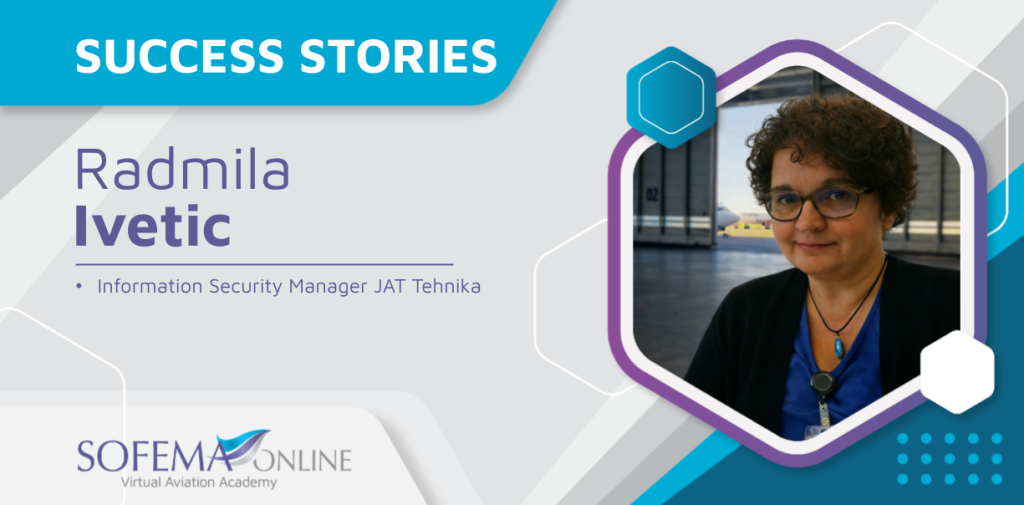
For over 15 years, Sofema has helped aviation professionals worldwide strengthen their expertise through practical regulatory training. In this Success Story, Radmila Ivetic from JAT Tehnika reflects on how Sofema training supported her journey toward becoming an Information Security Manager and implementing EASA Part-IS.
1. Could you briefly share your aviation background and your current role at JAT Tehnika?
Radmila: I have been working in aviation for almost 25 years, and my entire professional journey has been connected with JAT Tehnika.
For me, aviation was never just a profession. My father also worked in aviation, and although he passed away when I was still a child, that connection remained very strong. During my school years, I was a JAT scholarship holder, and in many ways, I grew up around hangars, workshops, and aircraft.
My first role was an engineering position in aircraft graphic design related to aircraft painting, which quickly became my first professional passion. It was a job where precision, patience, and attention to detail were essential every day.
Over the years, I moved through several roles, including Head of Interior Workshop, before transitioning into the regulatory and oversight side of aviation maintenance as a Compliance Auditor.
Today, I serve as Information Security Manager, responsible for implementing EASA Part-IS and ensuring that information security is understood as an operational, safety, and compliance matter within the organisation.
2. You mentioned that Sofema courses helped you build a solid knowledge portfolio. How did this training support your professional development over the years?
Radmila: Over the years, I completed many Sofema courses, and they became an important part of my professional development.
What I appreciated most was the breadth of the training portfolio. Through Sofema, I studied a wide range of aviation subjects, including Airbus and Boeing General Familiarisation, Aircraft Accident Investigation, Safety Management Systems, EASA Part-145, Part-IS, and Bowtie Risk Assessment.
The training followed my career in a very natural way. As my responsibilities expanded, the training evolved with them. It helped me connect experience with knowledge and theory with real aviation practice.
Looking back, I can say that Sofema training supported my development step by step and helped me build a broader and more confident professional foundation.
3. You have recently been nominated as Information Security Manager. In what way did Sofema training contribute to your readiness and confidence for this role?
Radmila: This role is both new and demanding, so the training helped significantly.
I already had many years of aviation, compliance, and auditing experience, but Sofema training helped me connect that background with the specific logic of EASA Part-IS.
The courses provided structure, direction, and a practical view of how implementation should work inside a real Part-145 organisation.
By the time I stepped into the ISM role, I was building on a broad Sofema training background across safety, compliance, investigation, maintenance regulation, and information security.
It was not just about gaining knowledge; it also gave me confidence because I could apply everything I had learned in a practical way.
4. What were the most valuable insights or practical tools you gained from the Bowtie Risk Assessment training?
Radmila: One of the most valuable aspects of the Bowtie Risk Assessment training was how clearly it explained the relationship between threats, unwanted events, consequences, and barriers.
In aviation, information security should not remain an isolated IT topic. It needs to be connected to operations, safety, and risk management.
The Bowtie methodology helped me analyse information security risks in a structured and visual way, which is particularly useful when implementing Part-IS requirements.
5. How did the courses help translate regulatory requirements into practical implementation?
Radmila: For me, this was one of the biggest advantages.
After working many years in aviation, you understand how organisations operate in reality. However, when new regulatory requirements appear, the real challenge is turning them into something practical and sustainable in daily work.
Sofema courses helped clarify the logic behind regulatory requirements and showed how they can be translated into practical implementation through procedures, responsibilities, and operational processes.
The supporting materials were also extremely valuable. Having access to practical documentation can make a real difference when organisations are working to implement complex regulatory frameworks.
6. If you had to summarize your experience with Sofema training in one sentence, what would you say?
Radmila :Sofema training followed my professional growth over the years and helped me turn experience into a more structured, practical, and confident approach to new aviation challenges.
We are grateful for Radmila Ivetic’s shared feedback and experience.
Pursuing an aviation career and feeling inspired to create your own Success Story? Do not hesitate to excel with Sofema. You have more than 500 + courses to choose from.
Check out our portfolio and reach us at [email protected].
Tags:
Sofemaonline, online learning, AviationSafety, AviationTraining, AircraftMaintenance, AviationCareers, AviationCompliance, AviationProfessionals, InformationSecurity, EASAPartIS, MROIndustry