AviationSafety

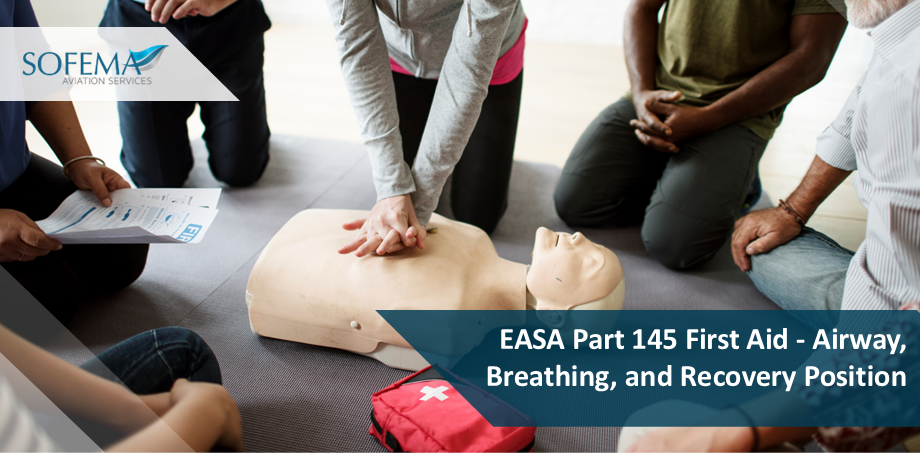
EASA Part 145 First Aid – Airway, Breathing, and Recovery Position

read more
EASA Part 145 First Aid - Airway, Breathing, and Recovery Position

November 03, 2025

Steven Bentley

Sofema Aviation Services looks at how to open the airway, check breathing, and place the person in the recovery position, both alone and with a helper. Airway: How to Open it Primary Option (adult & child): Head-tilt / chin-lift Kneel by the head. One hand on the forehead, gently tilt the head back. Two fingertips…

Free Cybersecurity Training Added to Quality & Safety Competence CAMO & AMO Learning Path Diploma

read more
Free Cybersecurity Training Added to Quality & Safety Competence CAMO & AMO Learning Path Diploma

October 29, 2025

Steven Bentley

Sofema Online (SOL) is pleased to announce that the Part 145 Cybersecurity Essentials course is now included at no additional cost in our Quality & Safety Competence in an EASA – CAMO & AMO Environment Learning Path Diploma. This limited-time offer provides aviation professionals with essential knowledge to identify and manage cyber risks while strengthening…

Performing Initial MSAT Certification Objectives and Outcomes

read more
Performing Initial MSAT Certification Objectives and Outcomes

October 28, 2025

Steven Bentley

Sofema Aviation Services (SAS) considers the role and purpose of the MSAT Tool. Purpose of Initial MSAT Certification The Initial MSAT assessment is used before granting initial certification to confirm that the organisation’s Management System (MS), including its Safety Management System (SMS) and Compliance Monitoring, are: Present – Documented in policies, manuals, and processes. Suitable – Adapted…

Boeing MEDA Considerations – Latent Conditions vs. Active Failures

read more
Boeing MEDA Considerations - Latent Conditions vs. Active Failures

October 24, 2025

Steven Bentley

Sofema Aviation Services (SAS) looks at the implications of Latent & Active Failures related to MEDA Investigations. Definitions (simplified) Active Failures: Front-line deviations that directly precede the event-slips, lapses, mistakes, or rule violations at the point of work (e.g., step omitted, wrong torque, cross-mated connector). Latent Conditions: Hidden system weaknesses that sit in the background…

Privacy Overview

This website uses cookies so that we can provide you with the best user experience possible. Cookie information is stored in your browser and performs functions such as recognising you when you return to our website and helping our team to understand which sections of the website you find most interesting and useful.