
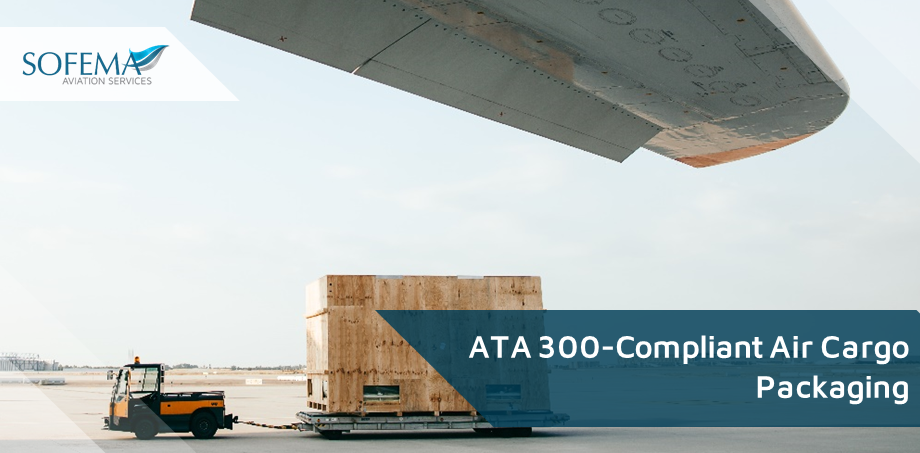
Sofema Aviation Services (SAS) Explores ATA 300: Marking & Labeling Standards, Container Construction, Material Selection, and Special Packaging Requirements
Introduction – ATA 300 provides a comprehensive framework to ensure that aviation parts and materials are transported safely, reliably, and in a cost-effective way.
Proper marking and labeling, correct material selection, robust container construction, and, where needed, specialized anti-static or climate-control features all contribute to a system where valuable aircraft components arrive ready for use without damage or delay.
Marking and Labeling Standards
Under ATA 300, proper marking and labeling of containers is essential for the efficient identification, tracking, handling, and management of aviation parts and materials.
Ref Reference: ATA 300, Section 2.8 — Marking and Labeling Requirements – ATA 300 specifies that each container must:
- Identify the Owner and User:
The container must clearly display the name of the owner (e.g., airline, MRO, OEM) and any specific user information. - Include a Unique Identification Number:
Containers must have a serial number or tracking code that allows easy identification throughout the logistics process. - Provide Handling Instructions:
Labels must indicate critical handling instructions such as:- “This Side Up”
- “Fragile”
- “Keep Dry”
- “Handle With Care”
- Display Container Category – The container should be labeled as Category I or Category II to indicate the durability classification and expected lifecycle (ATA 300, Revision 2023, Section 2).
- Conform to Durability Requirements – Labels and markings must be resistant to wear, abrasion, moisture, and fading. ATA 300 specifically states that markings should remain legible for the entire expected service life of the container.
- Meet International Standards Where Needed – In some cases (e.g., IATA requirements), containers must also carry internationally recognized symbols for air transport, hazardous materials, and customs compliance.
Specifications for Container Construction and Testing – ATA 300 defines strict specifications for container construction to ensure they withstand the stresses of air transportation.
Construction Requirements include:
- Durability – Containers must be robust enough to survive repeated handling, including loading and unloading by forklifts, stacking, vibrations during flight, and rough handling on ramps.
- Repairability – The design must allow for easy repair, with replaceable components where practical.
- Shock Absorption – Containers should incorporate internal cushioning systems to protect delicate components from impacts and vibrations.
- Weather Resistance – Construction must provide resistance to rain, dust, and moderate temperature swings. Seals, gaskets, or waterproof coatings are often incorporated.
Testing Requirements include the following :
- Drop Testing – The container must survive a series of drop tests from specified heights without damage to either the container or its contents.
- Vibration Testing – Simulated vibration exposure mimics aircraft and truck transportation conditions to ensure containers can withstand prolonged periods of shaking without structural failure.
- Stacking Test – Containers must support a minimum stacking load to ensure they do not collapse under their own weight during cargo loading or storage.
- Environmental Testing – If applicable, containers are subjected to environmental stress tests, including thermal cycling, moisture exposure, and UV exposure.
Reference – ATA 300, Section 3 — Container Construction and Performance Testing.
Material Selection (Plastics, Metals, Composites)
The material selection for ATA 300-compliant containers is critical for meeting performance, durability, and weight efficiency standards.
Plastics – Use – Lightweight components such as paneling, internal trays, and cushioning.
- Materials Commonly Used – High-density polyethylene (HDPE), polypropylene, and impact-resistant ABS plastics.
- Advantages – Lightweight, corrosion-resistant, easy to mold into complex shapes.
- Limitations – Less durable under heavy load stresses compared to metals; may degrade under UV exposure if not treated.
Metals – Use Structural frames, reinforcement ribs, and container exteriors for heavy or mission-critical parts.
- Materials Commonly Used – Aluminum alloys (especially 6061 and 7075 grades), stainless steel.
- Advantages – Extremely strong, highly durable, capable of withstanding heavy impacts and high stacking loads.
- Limitations – Heavier than plastics; risk of corrosion if improperly treated.
Composites – Use – Increasingly favored for high-performance containers, especially for aerospace and military applications.
- Materials Commonly Used – Glass fiber-reinforced plastics (GFRP), carbon fiber composites, hybrid laminates.
- Advantages – Best balance of weight and strength, excellent durability, high environmental resistance.
- Limitations – Higher manufacturing cost compared to metals or plastics.
Reference – ATA 300, Section 3.4 — Recommended Materials for Reusable Containers.
Anti-Static and Climate-Controlled Packaging – Special packaging requirements under ATA 300 and best practices in aviation logistics include:
Anti-Static Packaging – Purpose – To protect sensitive electronic parts (e.g., avionics units, circuit boards) from electrostatic discharge (ESD) which can destroy delicate components.
- Techniques:
- Use of anti-static plastics and foam materials.
- Use of conductive bags or static shielding materials inside the container.
- Grounding straps or internal conductive liners to discharge static safely.
Compliance Note – Anti-static packaging must not interfere with the mechanical protection provided by the container structure.
Additional Guidance – Referenced in industry best practices such as IPC/JEDEC J-STD-033 and IEC 61340-5-1 for handling ESD-sensitive devices.
Climate-Controlled Packaging – Purpose – To protect temperature-sensitive parts (e.g., battery packs, composite material components, temperature-calibrated instruments) from thermal degradation.
- Techniques:
- Use of insulated containers or temperature-controlled enclosures.
- Use of gel packs, phase-change materials, or portable refrigeration modules.
- Special internal conditioning materials that maintain a stable temperature during transport.
- Testing and Compliance – Containers requiring active or passive thermal control may need additional performance testing under simulated temperature cycling to ensure consistent part protection.
Note – Climate-controlled containers are not explicitly detailed in the main ATA 300 specification but are referenced as “optional enhancements” where operational needs dictate.
Next Step
Sofema Aviation Services (www.sassofia.com) and Sofema Online (www.sofemaonline.com) provides EASA Compliant, classroom, webinar and online training across multiple supply chain areas, including stores inspection requirements please see the websites or email [email protected]
Tags:
ATA 300 Category, ABS plastics, polypropylene, High-density polyethylene (HDPE), Stacking Test, Vibration Testing, gaskets, service life, container construction, labeling, climate-control features, MRO, hazardous materials, aviation parts, Abrasion, aluminum surfaces, Anti-Static Agents, Aircraft components, SAS blogs, Air Transport Aircraft, IATA, OEM