Sofema Aviation SA takes a deep dive into the CAMO Compliance Requirements and Oversight Activities.
Introduction
The gap between regulatory compliance (meeting the minimum legal standards) and effective CAMO oversight of the AMO (ensuring the actual physical integrity and therefore optimum reliability of the fleet) is where most operational risk resides.
While compliance is binary, asking the right follow-up questions is essential, which means oversight is qualitative and requires a deep, technical “interrogation” of the maintenance process.
When a CAMO treats compliance as the destination rather than a step on the journey, the operator potentially faces significant reliability exposure.
The Administrative vs. Physical Gap
A CAMO may appear to be 100% compliant with Part-CAMO while never actually looking at the aircraft. Consider that the Regulations require a CAMO to manage records, verify AD/SB compliance, and update the Aircraft Maintenance Program (AMP). These are essentially administrative tasks.
- Important Note: If oversight activities are limited to reviewing completed task cards, the CAMO effectively outsources its technical judgment to the Part 145.
- The Risk: Corroded seat tracks, leaking actuators, or degraded wiring looms may be “signed off” as inspected by the MRO.
- If the CAMO oversight does not include physical “sample” inspections during the maintenance input, they are blind to the fact that the inspection may have been superficial.
Reliability Oversight – Data Management: Developing Predictive Methodology
- An effective CAMO will focus on understanding the data to determine why a component was changed. (What was the nature of the Failure)
- Details of the failure conditions and whether the failure within the expected range of performance
- Is there a potential correlation between this failure and the MRO team that performed the last C-Check?
Important Note
If the CAMO loses detailed sight of the “hardware,” they often lose the ability to perform Predictive Oversight, retreating into the safety of Historical Compliance.
The Inspector Competence Gap: Poor workmanship is often masked by the “ease” of component replacement.
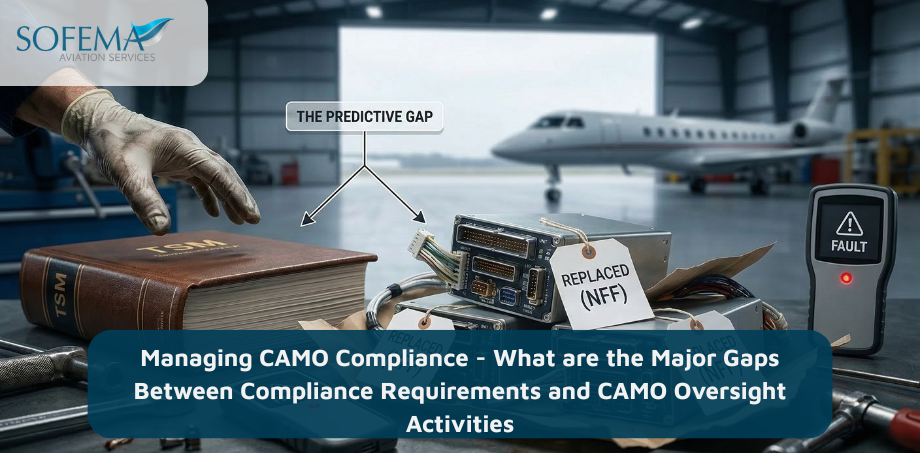
The “Shotgun” Troubleshooting Issue: If a Part 145 inspector lacks the competence to perform a deep-system integration test, they may “shotgun” the system, replacing expensive components until the fault goes away.
- The Compliance View: Three components were changed, and three CRSs were issued. Compliant.
- The Oversight View: The inspector didn’t follow the Troubleshooting Manual (TSM) logic.
A Potential Airworthiness Review Gap – The Airworthiness Review Certificate (ARC) process may be mistaken for a deep-dive technical audit.
- The Gap: An Airworthiness Review is potentially a “survey of a sample.” It verifies that the records match the physical configuration. However, it does not typically test the quality of the maintenance performed.
- The Reality: An aircraft can have a perfectly valid ARC while harboring latent maintenance-induced functional failures.
>> Because the ARC inspector (often within the CAMO) is looking for compliance with the program, they may miss the fact that the inspectors at the 145 are consistently missing specific issues
The Operator’s Exposure and Reliability Shortfalls
The operator is the ultimate stakeholder. When the CAMO fails to provide adequate oversight of the 145, the consequences manifest as Reliability Shortfalls:
- Technical Dispatch Reliability (TDR) Drops: Frequent AOGs for issues that should have been caught during heavy maintenance checks.
- Premature Component Removals: High “No Fault Found” (NFF) rates at the workshop because the line maintenance team (acting under poor oversight) is “shotgunning” parts rather than performing root-cause troubleshooting.
- Safety Margin Erosion: The accumulation of “minor” deferred defects that, in aggregate, significantly increase the pilot’s workload during an emergency.
CAMO Oversight – Important Consideration
Oversight is not a “policing” function; it is a “risk-mitigation” function.
- The CAMO must act as the advocate for the aircraft’s long-term health.
- Without this oversight, the 145 will naturally gravitate toward the path of least resistance (meeting the minimum legal requirement for the lowest internal cost)
- The resulting “reliability gap” is a potential cost burden for airline profitability.
Best Practices for Bridging the Gap
To move from passive compliance to active management, a CAMO must adopt a more “intrusive” oversight model.
Independent Technical Sampling: A CAMO should not just audit the “Process”; they must audit the “Product.”
- Performing independent physical surveys of the aircraft during deep maintenance allows the CAMO to assess the true quality of the 145’s inspectors.
The Resident Representative (The “Eyes on the Ground”) – For any major maintenance event, the CAMO should have a technical representative on-site.
- This person serves as the bridge. They should be empowered to challenge the 145’s findings and, more importantly, their “non-findings.”
The Contractual vs. Competency Gap
CAMOs often rely on the “Contractual Oversight” of the Part 145. The logic is: “We have a contract with an approved 145; therefore, their work is guaranteed.”
The Gap: This ignores the “Competence Gap”. The 145 organization is a legal entity, but the work is done by humans.
The Challenge: A major oversight gap is the failure to audit the Man-Hour Plan against the Actual Work Performed. If a heavy check requires 10,000 man-hours but is completed in 7,000, a compliance-led CAMO might celebrate the early return to service.
Important Note to Take Away: An oversight-led CAMO would be alarmed to learn that 3,000 hours of “looking” were skipped, likely leading to reliability shortfalls three months down the line.
Next Steps:
Join Sofema Aviation for a CAMO Compliance Challenges webinar on Tuesday, 24 March, from 10:30 – 13:00 Sofia time. Register for the webinar here – places are limited, so be sure to secure your spot early.
Explore our extensive course library featuring 500+ aviation training courses and take the opportunity to deepen your regulatory knowledge, or email [email protected] for support.
Tags:
CAMO, AviationSafety, AviationMaintenance, CAMO oversight, AviationCompliance, ContinuingAirworthiness, EASAPartCAMO, CAMO Compliance, AircraftReliability, CAMOOversight, MROManagement