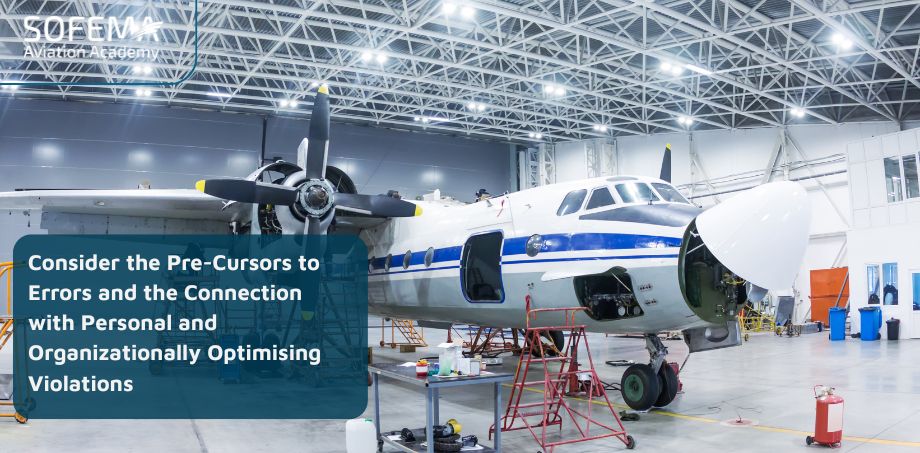
Pre-cursors to Errors – Pre-cursors are the conditions, psychological, physical, or environmental, that increase the probability of an individual making a mistake.
These are often referred to as Performance Influencing Factors (PIFs).
Exposures
- Individual Stressors: High workload, fatigue, lack of sleep, or personal anxiety.
- Workplace Environment: Poor lighting, excessive noise, or poorly designed interfaces (e.g., two identical buttons with opposite functions).
- Task Demands: Tasks that are overly complex, repetitive (leading to boredom), or time-pressured.
Challenges
The primary challenge is that many pre-cursors are “invisible” until an incident occurs. For example, a worker might be “on the clock” but mentally fatigued, a state that is difficult for management to quantify without active reporting or monitoring.
Best Practices
- The “HALT” Principle: Encourage employees to stop if they feel Hungry, Angry, Lonely, or Tired.
- Ergonomic Audits: Periodically assess the physical and digital workspace to reduce cognitive load.
- Fatigue Management Systems: Implement mandatory rest periods and shift-rotation schedules based on circadian rhythms.
Personal Optimising Violations
These occur when an individual deliberately breaks a rule to suit their own personality or perceived needs, rather than for the benefit of the task itself.
Exposures
- Thrill-seeking: Breaking a rule just to see if they can get away with it or to make a mundane task more “exciting.”
- Skill Demonstration: Over-confidence leading a worker to bypass safety checks because they believe they are “too good” to need them.
Challenges
These violations are often the hardest to manage because they are rooted in individual psychology. They can be contagious; if a senior “expert” bypasses a rule for personal convenience, junior staff often follow suit to fit in.
Best Practices
- Cultural Realignment: Shift the “hero” narrative from the person who works fast to the person who follows the protocol perfectly.
- Peer-to-Peer Accountability: Empower team members at all levels to call out “cowboy” behavior without fear of social repercussion.
Organisationally Optimising Violations
These are deviations from the rules intended to get the job done more efficiently or to meet organizational targets. Interestingly, the employee often thinks they are doing the company a favor.
Exposures
- Resource Constraints: Not having the right tools, leading workers to “improvise” with unsafe alternatives.
- Production vs. Safety Pressure: When management emphasizes “meeting the quota” above all else, workers will naturally cut corners to stay employed.
- “The Way We Do Things”: When the official rulebook is so outdated or impractical that following it would make the job impossible.
Challenges
The organization often implicitly rewards these violations, until something goes wrong. If a worker cuts a safety corner and finishes two hours early, they are praised for productivity. If that same corner-cutting leads to an explosion, they are blamed for the error. This is known as Outcome Bias.
Best Practices
- Review “Work-as-Imagined” vs. “Work-as-Done”: Regularly compare official SOPs (Standard Operating Procedures) with how the work is actually happening on the floor. If people are breaking a rule to get the job done, the rule is likely the problem, not the people.
- Psychological Safety: Ensure workers can report that a rule is “unworkable” without being disciplined.
The Connection: The Path to Incidents
The link between precursors and violations is often a feedback loop.
- The Catalyst: High Task Pressure (an organizational precursor) leads to an Organisationally Optimising Violation (skipping a safety check to save time).
- The Normalization: When no accident occurs, the violation becomes the “new normal.”
- The Error: Eventually, a personal precursor (like Fatigue) interacts with this weakened system, and a catastrophic error occurs.
Management Focus Areas
- To address Error Pre-cursors: Focus on the environment and physiology through ergonomics and fatigue management.
- To address Personal Violations: Focus on individual attitude through behavioral coaching and peer review.
- To address Org. Violations: Focus on systemic pressure by creating practical SOPs and a safety-first culture.
Next Steps
Explore 525+ aviation courses at Sofema, or contact [email protected] for support.
Tags:
Human Factors, Risk Management, Safety Culture, Sofema Aviation Services (SAS), Sofema Aviation (SA), Performance Influencing Factors (PIFs), Psychological Safety