Sofema Aviation www.sofemaaviation.com considers the relationship between parts availability and MEL usage and variations, how to manage this problem compliant with SMS ALARP
Introduction – The Operators Triple Threat
- The Financial Burden of Surplus –When a business over-invests in inventory to avoid AOGs, it creates a “material cost” burden. As well as the initial purchase price
- Holding Costs: Warehousing, insurance, and the specialized climate control required for sensitive avionics or composites.
- Technical Obsolescence: Service Bulletins (SBs) or Airworthiness Directives (ADs) might render a part unusable or require expensive modifications while it’s still sitting in the box.
- Administrative Requirements: Every part requires a valid EASA Form 1 or FAA 8130-3. Managing the traceability for a large inventory is an additional administrative burden.
The AOG (Aircraft on Ground) Nightmare – Not having enough parts is the most visible failure of a CAMO. An AOG triggers a cascade of costs:
- Recovery Logistics: Chartering a flight to move a spare engine or hiring a “Go-Team” of engineers.
- Brand Erosion: Frequent delays due to “technical issues” (read: no parts) kill passenger loyalty and can lead to regulatory scrutiny regarding your operational control.
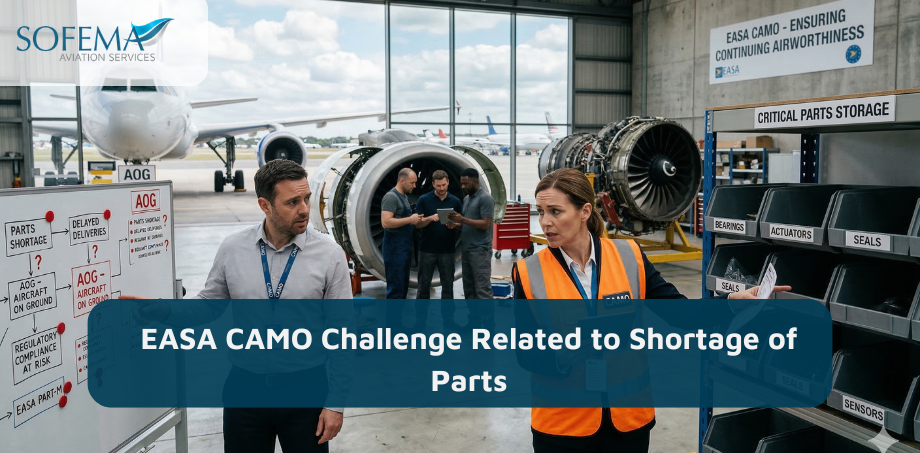
The MEL Exposure & “The Snowball” – When you don’t have the part, you defer the defect via the Minimum Equipment List (MEL). Operating at ALARP means you can’t just keep deferring indefinitely.
-
- Reduced Redundancy: If the MEL allows you to defer you are now only 1 additional failure away from an AOG situation.
- Operational Restrictions: You might lose ETOPS capability or the ability to land in low visibility (CAT II/III), which forces diversions and increases fuel burn.
- Shortage Complications: If a specific part is globally short (e.g., a specific actuator), your entire fleet might end up on the same MEL. This creates a “fleet-wide fragility” where a single further failure could ground the entire operation.
How to Manage at ALARP – To keep risk “As Low As Reasonably Practicable,” consider to move from reactive to predictive management.
- Dynamic Provisioning: Instead of buying “just in case,” use reliability data to identify “No-Go” items (parts that have no MEL relief). If it has no MEL relief, you must have it in stock or on a high-speed exchange contract.
- The “MEL Buffer”: Establish a policy where no more than, say, 25% of the fleet can have “Category B” MELs open simultaneously. If you hit that limit you implement additional recovery actions (Pseudo AOG)
- Robbery Control: This is a controversial but necessary tool using Maintence Check Aircraft as donors to clear MELs on the active fleet. This keeps the “live” fleet at a higher level of redundancy.
MEL & Part Shortage Risk Assessment
To help a CAMO manager justify a decision (like a robbery or an expensive AOG purchase) while demonstrating to regulators that they are operating at ALARP.
1.Hazard Identification
- Primary Hazard: Continued operation with [Part Name] inoperative under MEL [Reference #].
- Secondary Hazards: Loss of CAT III capability, increased crew workload, or potential for compounding failures (e.g., if the redundant system fails).
2.Risk Analysis
Use the formula:
- Severity: (Minor / Major / Hazardous / Catastrophic)
- Note: Consider what happens if the remaining redundant system fails.
- Likelihood: (Frequent / Occasional / Remote / Extremely Improbable)
- Note: Based on MTBF (Mean Time Between Failure) data for the remaining system.
3.Mitigation Strategies (ALARP Measures)
- Operational Mitigations: (e.g., Restricted to Day VFR only; No ETOPS;).
- Maintenance Mitigations: (e.g., Additional functional test of the remaining redundant system).
- Logistical Mitigations: (e.g., Part has been sourced via AOG desk with ETA of 48 hours; robbery authorized.
4.Impact on Fleet Resilience
- How many other aircraft in the fleet are currently using this specific MEL?
- What is the cumulative risk if a fleet-wide issue develops?
5.Approval & Review
- CAMO Manager Signature: ____________________
- Flight Ops Manager Signature: ____________________
- Re-assessment Date: [Usually 72 hours for Cat B items]
Next Steps
Join Sofema Aviation for a CAMO Compliance Challenges webinar on Tuesday, 24 March, from 10:30 – 13:00 Sofia time. Register for the webinar here – places are limited, so be sure to secure your spot early.
Explore our extensive course library featuring 500+ aviation training courses and take the opportunity to deepen your regulatory knowledge, or email [email protected] for support.
Sofema Aviation Services (SAS) and Sofema Online (SOL) provide classroom, webinar, and online training. Please see the websites or email [email protected].
Tags:
EASA Part M, continuing airworthiness management, sasblogs, Sofema Online (SOL), EASA CAMO Part Shortage, Aircraft Maintenance Planning ALARP, MEL Defect Rectification, Aviation Supply Chain Crisis, Part-145 compliance, (AOG) Risk Assessment, MEL usage, Sofema Aviation (SAS)