

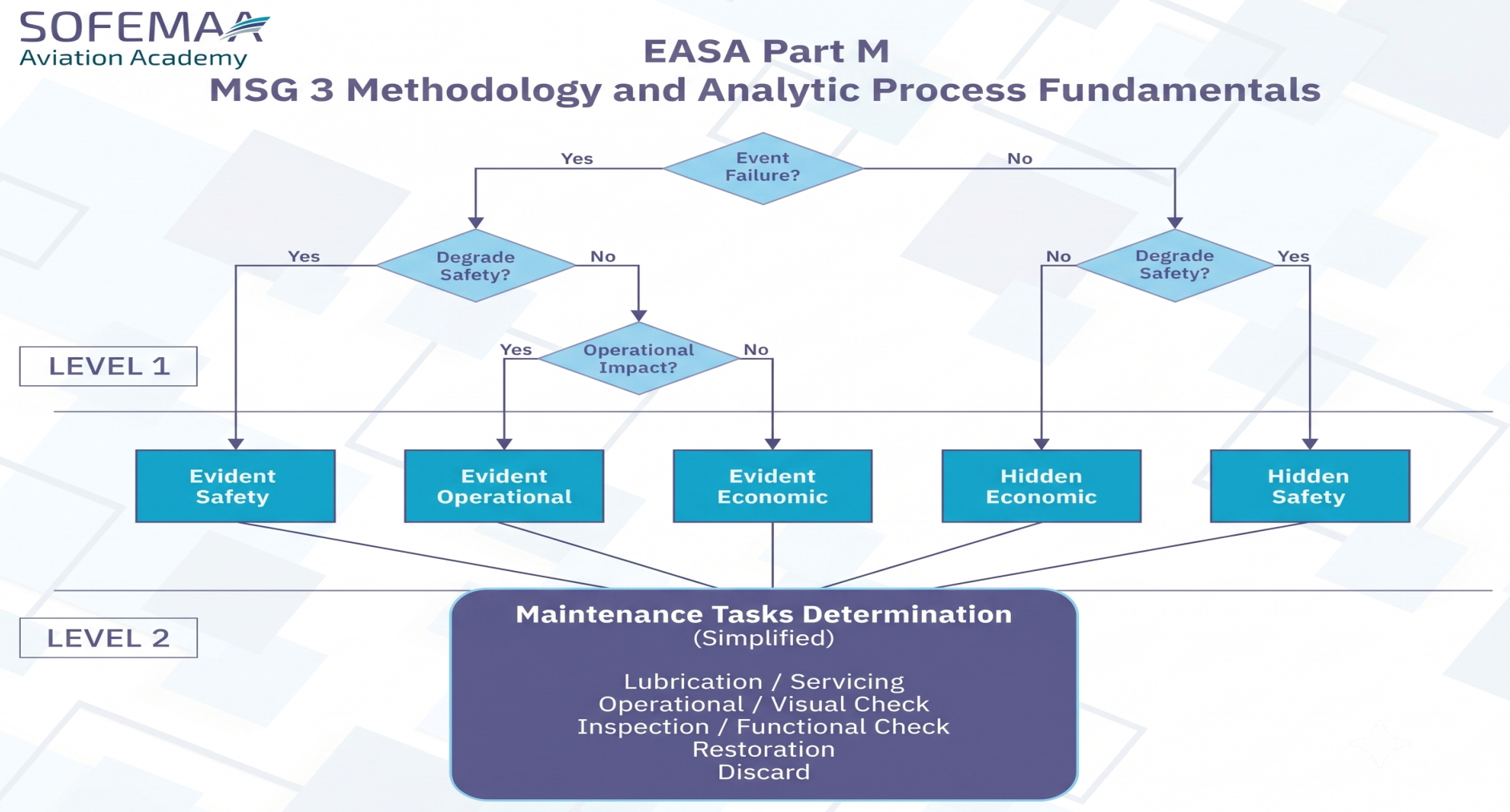
The diagram provided outlines the logic flow used to determine the necessary maintenance tasks for an aircraft component, ensuring high safety standards and optimized operational costs as required by EASA Part M. We follow the lifecycle of a component – like a complex hydraulic pump – to illustrate how this framework is applied.
Chapter 1: The Core Principle – Is the Failure Evident?
Before deciding how to maintain a part, we must understand its nature. The entire MSG-3 analysis hinges on a simple question: Will a functional failure become apparent to the operating crew?
- We start with our subject: a component with the potential for failure.
- The Decision: The maintenance technician asks, “If this part fails, will we know immediately?”
- This first analysis point in the MSG 3 Philosophy.jpg diagram is critical because it divides components into two very different maintenance categories.
Chapter 2: Level 1 Analysis – The Consequences of an Evident Failure
We move forward assuming the failure is EVIDENT. When a failure is obvious (for example, a large fluid leak or a direct cockpit warning light), the logic must determine the impact of that failure.
- Degrade Safety? If the answer is ‘Yes,’ the failure category is immediately EVIDENT SAFETY. This is the highest priority. A critical task must be assigned to prevent this, such as a time-limited discard or mandatory functional inspection.
- Operational Impact? If the failure doesn’t compromise safety but grounds the aircraft (like a nose wheel steering issue on the ground), the answer to safety degradation is ‘No,’ and we ask about operation. A ‘Yes’ here results in EVIDENT OPERATIONAL. We need a maintenance task, likely an operational check or restoration, to minimize downtime.
- Economic Consequences only? If the answer to both previous questions is ‘No,’ the failure is purely EVIDENT ECONOMIC. The maintenance task chosen will be purely cost-driven – preventing more expensive damage down the line.
Chapter 3: Level 1 Analysis – The Consequences of a Hidden Failure
If Chapter 1 answered ‘No,’ the failure is HIDDEN. This is dangerous because a crucial part could be broken and no one knows, until a second failure in a backup or related system makes the problem catastrophic.
- Degrade Safety? We use the same safety question from MSG 3 Philosophy.jpg. If a hidden failure could directly lead to a major safety event when a secondary system fails, the consequence is HIDDEN SAFETY. This demands rigorous, scheduled intrusive testing and functional checks to expose the fault.
- If a hidden failure doesn’t degrade safety, the consequence is HIDDEN ECONOMIC. Like its evident counterpart, tasks are based on cost-benefit analysis.
Chapter 4: Level 2 Analysis – The Action Plan and Task Determination
Once we know the consequence of the failure (from Chapters 2 & 3), we move to Level 2 Maintenance Task Determination. This is the practical side of the story—where we decide exactly what the maintenance program will require. We reference the results and choose from the standard task list provided in the reference image:
- Lubrication/Servicing: Used generally across categories.
- Operational/Visual Check: Used often for ‘Evident Safety’ to check warnings, or ‘Evident Operational’ to confirm function quickly.
- Inspection/Functional Check: Crucial for identifying ‘Hidden Safety’ and ‘Hidden Economic’ failures.
- Restoration: Targeted at ‘Evident Operational’ and economic impacts to overhaul worn parts before failures.
- Discard: Applicable to all categories as a absolute preventative measure, especially for ‘Evident Safety’ items with known lifespans.
Chapter 5: The Outcome – The Integrated Maintenance Program
The logic analysis from Chapter 4 is not theoretical. All these individual decisions, derived from the core principles of the MSG 3 Philosophy, are synthesized into the Maintenance Review Board Report (MRBR). ( Basis for the maintenance planning document (MPD). These aren’t just lines on a chart; they are the approved maintenance intervals and procedures that keep the airline legal and safe under EASA Part M.
Chapter 6: The Outcome – Continuous Improvement and Review
The final stage of the story is feedback. Maintenance is dynamic. Data from operations is analyzed; reliability reports are reviewed. If a task isn’t working as intended, the feedback loop triggers a re-analysis. The entire original flowchart loop shown in MSG 3 Philosophy is refined. The program is updated to be smarter, safer, and more cost-effective. This creates a continuous cycle of improved safety and optimized efficiency, ensuring that the maintenance philosophy remains current and effective for the life of the aircraft.
Next Steps
Explore 525+ aviation courses at Sofema, or contact [email protected] for support.
Tags:
Maintenance Review Board Report, MRBR, Sofema Aviation Services (SAS), Sofema Aviation (SA), MSG-3 philosophy, aircraft maintenance programs, EASA Part M compliance, aviation maintenance logic tree, MSG-3 failure evident hidden, commercial aviation maintenance tasks