
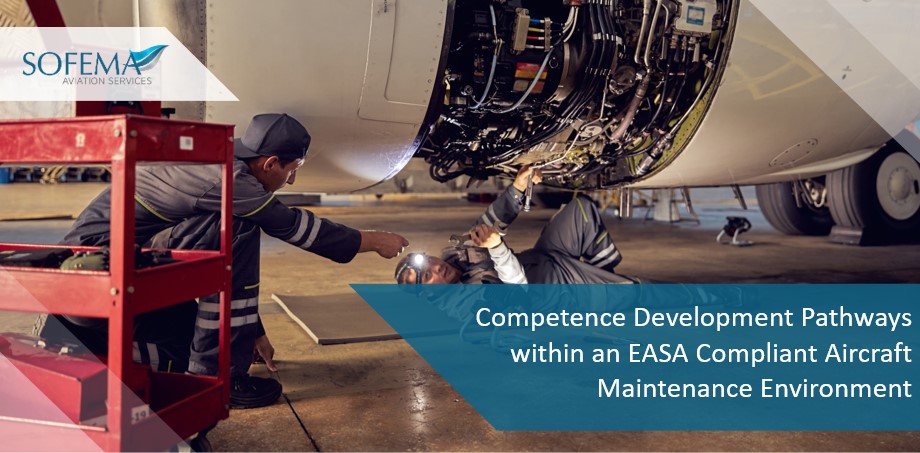
Sofema Aviation Services and Sofema Online considers the importance of developing competence pathways to maximize the level of engagement and effectiveness of all employees.
Introduction
In the context of aircraft maintenance, Competence Development Pathways (CDPs) within the European Union Aviation Safety Agency (EASA) framework should be designed to ensure that maintenance personnel acquire, maintain, and continuously improve the skills and knowledge necessary to uphold the safety and airworthiness of aircraft.
These pathways can be considered essential for maintaining high standards in a highly regulated and safety-critical industry.
Structured Learning and Progressive Training
Aircraft maintenance training (only 1 part of the entire story – with various additional organisational roles to also be considered) within an EASA environment follows a structured and progressive learning pathway.
- Trainees typically begin with foundational training, such as the EASA Part-66 Basic Training, which covers theoretical knowledge and basic practical skills. This is followed by more specialized training as they progress to specific aircraft types or maintenance activities.
Competency-Based Training and Assessment (CBTA)
CBTA is integral to CDPs in EASA-regulated environments. The focus is on ensuring that maintenance personnel can perform specific tasks to the required standard, rather than just knowing the theory.
- Competencies such as fault diagnosis, manual dexterity, and the ability to follow complex procedures are emphasized.
- Assessments are practical and scenario-based, designed to verify that technicians can apply their skills and knowledge in real-world situations, ensuring compliance with EASA regulations.
Continuous Professional Development (CPD) and Recurrent Training
EASA regulations promote continuous professional development to ensure that maintenance personnel remain competent throughout their careers.
- This includes recurrent training, often mandated at regular intervals, to keep technicians updated on the latest procedures, technologies, and regulatory changes. EASA Part-145 organizations, which are responsible for aircraft maintenance, must ensure that their staff undergo regular training and assessments to maintain their certification and competence.
Integration of Human Factors and Soft Skills
Human factors training is a critical component of Competence Development Pathways in EASA environments. This training addresses non-technical skills that are crucial in aircraft maintenance, such as communication, teamwork, and error management. EASA mandates that maintenance organizations incorporate human factors training into their programs to reduce the risk of human error, which is a significant contributor to maintenance-related incidents.
Personalized Learning Pathways
Given the diversity of tasks within the aircraft maintenance environment, personalized learning pathways are often implemented.
- These pathways consider the specific roles and responsibilities of individuals allowing for tailored training that addresses their unique needs and career goals. For example, a technician specializing in avionics might have a different training pathway compared to one focusing on structural repairs, ensuring that each achieves the necessary competence in their respective area.
Use of Advanced Training Technologies
To encourage the use of advanced technologies in training, such as virtual reality (VR), augmented reality (AR), and simulation-based training. These technologies allow maintenance personnel to practice complex procedures in a controlled, risk-free environment
Regulatory Compliance and Standardization
Competence Development Pathways in an EASA environment should where appropriate demonstrate compliance with EASA regulations, particularly those outlined in EASA Part-66 (certifying staff), Part-145 (maintenance organizations), and Part-147 (approved training organizations).
- These regulations set the standards for training content, duration, and assessment methods. Compliance ensures that all maintenance personnel across the EU and EASA-compliant regions meet consistent safety and competence standards, facilitating mobility and trust in the global aviation market.
Feedback and Continuous Improvement
Feedback mechanisms are crucial in a process to deliver effective CDPs.
- Maintenance personnel receive ongoing feedback during training, which helps them identify areas for improvement.
- Approved Maintenance Organizations are required to have quality management systems that should include regular assessment of competence management and training programs.
Safety Culture Integration
A strong safety culture is fundamental part of Competence Development Pathways and should be both visible and reinforce this culture.
From the beginning of their training, all maintenance personnel should be instilled with a mindset that prioritizes safety above all else. This includes strict adherence to maintenance procedures, meticulous documentation, and proactive reporting of any safety concerns or potential issues. The goal is to develop not only technically competent individuals but also professionals who are deeply committed to maintaining the highest levels of safety.
Cross Functional Development
Staff often find themselves in roles that require cross-functional collaboration, interacting with various departments such as engineering, procurement, and quality assurance. Competence Development Pathways include training on leadership and collaboration, preparing these personnel to coordinate effectively with different teams. This training is essential for ensuring that all departments are aligned in their goals, reducing the risk of miscommunication, and enhancing overall efficiency.
Competence Development Pathways should be designed to ensure these personnel are well-equipped to manage the complex challenges inherent in maintaining airworthiness. Through a combination of regulatory knowledge, competency-based training, continuous professional development, and integration of soft skills and advanced technologies, these pathways contribute significantly to the safety, efficiency, and compliance of aircraft maintenance operations.
Next Steps
The implementation of CDPs, as outlined by Sofema Online, ensures that all maintenance personnel are equipped to handle the complexities of their roles. This holistic approach to competence development contributes to the global trust in the aviation industry, allowing for consistent safety standards across EASA-compliant regions.
For organizations operating within an EASA framework, it is imperative to prioritize the development and implementation of Competence Development Pathways tailored to their specific needs. By partnering with Sofema Online, your organization can access comprehensive training solutions that align with EASA regulations and industry best practices.
Take the first step towards enhancing your team’s competence and operational safety by exploring Sofema Online’s tailored training programs. Ensure your maintenance personnel are not only compliant but are also leaders in the industry, equipped with the latest skills and knowledge to maintain the highest standards of airworthiness. Visit www.sofemaonline.com today to learn more and start your journey toward excellence in aircraft maintenance. Email [email protected]
Tags:
Aircraft, EASA, Airworthiness, Competence, SAS blog, Maintenance Personnel, Competence Development Pathways, Aircraft Maintenance Environment, the European Union Aviation Safety Agency (EASA), safety-critical industry