
Sofema Aviation Services (SAS) considers the key features of an effective SMS Management of Change Process.
Introduction – Reality Check
MoC is no longer optional, it is a mandatory component of the “Safety Risk Management” pillar of your Management System.
Regulatory References and Applicability
- For Air Operations under Regulation (EU) No 965/2012, the Management of Change (MoC) requirement is found in ORO.GEN.200(a)(3) within Part-ORO, applying to Air Operator Certificate (AOC) holders, as well as specialized (SPO) and non-commercial (NCC) operators.
- For Continuing Airworthiness under Regulation (EU) No 1321/2014, the requirements are located in CAMO.A.200(a)(3) and 145.A.200(a)(3), targeting Continuing Airworthiness Management Organisations (CAMO) and Part-145 maintenance organisations, respectively.
Terminology and Operational Triggers
Both regulations utilize the identical terminology, “Management of Change,” to describe this safety assurance process.
- The triggers that initiate the process reflect the unique risks of each environment.
- Air Operations triggers generally focus on dynamic elements such as changes in scope, the introduction of new routes, new aircraft types, or changes in key personnel.
- In contrast, Continuing Airworthiness triggers are more static and infrastructure-heavy, focusing on changes in facilities, tooling, procedures, scope of approval, and key personnel.
The Approval Process for Significant Changes
The regulatory oversight mechanism is virtually identical between the two. Both domains distinguish between minor changes and “significant changes.” For significant changes, both regulations mandate prior approval from the Competent Authority (CA) before implementation.
- This legal obligation is codified in ORO.GEN.130 for Air Operations, and mirrors 145.A.85 or CAMO.A.130 for the engineering side.
Note Regarding System Maturity
- A key distinction lies in the maturity of implementation. Air Operations organizations generally possess “High” maturity regarding MoC, having been mandated to implement SMS since approximately 2014.
- Continuing Airworthiness organizations are often considered “Developing” in this area, as the full mandate for SMS integration (Phase 2) is a more recent regulatory development, meaning the culture of formal change management is less entrenched in maintenance environments than in flight operations.
MOC Mandates
The regulation mandates that organizations identify aviation safety hazards associated with their activities. Since “change” is the single biggest introducer of new hazards into a stable system, EASA requires a formal process to manage these transitions before they are implemented.
- “Unless they are properly managed, changes in organisational structure, facilities, the scope of work, personnel, documentation, policies and procedures, etc. can result in the inadvertent introduction of new hazards, and expose the organisation to new or increased risk.”
The Role of MoC: More Than a Form
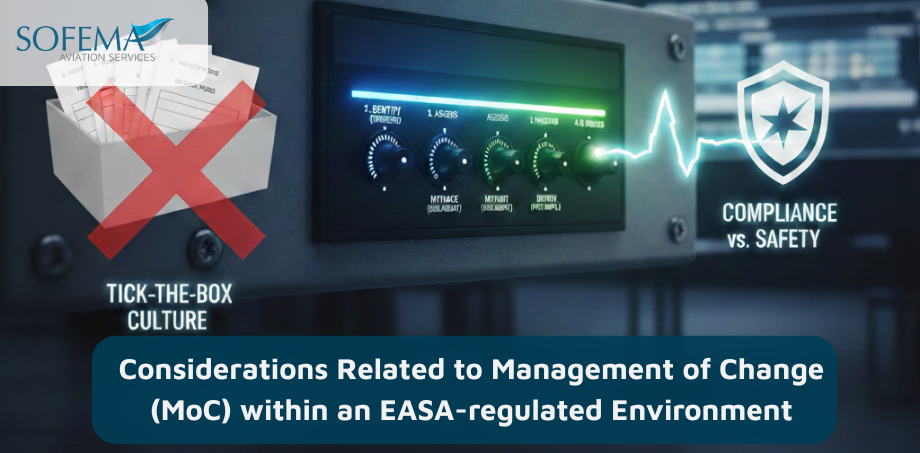
The role of MoC is to bridge the gap between “Compliance” (following the rule) and “Safety” (managing the risk). In an effective SMS, MoC acts as a circuit breaker.
When a change is proposed (e.g., introducing a new aircraft type, changing the shift pattern, switching software, or losing a key Postholder), 2the MoC process forces the organization to pause and ask:
- What is changing?
- Who and what else does this impact? (Interfaces)
- What could go wrong? (Hazard Identification)
- Is it safe enough to proceed? (Risk Assessment
Identifying the Challenges
Implementing MoC in aviation is historically difficult due to the operational tempo.
- Defining “Change”: One of the biggest hurdles is the threshold. Does a change in a roster require an MoC? Does a change in the coffee supplier? Organizations struggle to define “significant change,” leading to either paralysis (assessing everything) or negligence (assessing nothing).
- Timing: MoC is often triggered too late. In many ineffective systems, the MoC form is completed after the change has already been decided or even implemented, turning it into a retrospective justification rather than a risk management tool.
- Siloed Thinking: Many managers often view changes in isolation.
- Example: “We are just changing the tooling supplier.”
- Missed Hazard: The new tools use different units of measurement or require different connectors, which can lead to maintenance errors.
Reluctance and the Difficulty in Building Culture
Reluctance to engage with MoC usually stems from a perception that it is an “obstruction to progress.”
- The “Can-Do” Attitude Trap: Aviation maintenance culture prizes “getting the job done.” MoC is often viewed as “Safety Prevention,” a bureaucratic layer that slows down necessary operational agility.
- Fear of Accountability: If a manager raises a risk via MoC, they are now responsible for mitigating it. It is often easier to pretend the risk doesn’t exist than to document it and fight for the budget to fix it.
- Cultural Inertia: In legacy organizations, staff may say, “We’ve changed procedures a hundred times before without this paperwork, and we didn’t crash.” This survivorship bias makes them resistant to the new systematic approach required by EASA.
The Problem with Lack of Management Buy-In
MoC is the litmus test for Management Buy-in. An Accountable Manager can easily sign a Safety Policy, but MoC requires them to potentially delay a profitable activity for safety reasons.
- Resource Allocation: Effective MoC requires resources (time, training, new equipment) to mitigate risks. If management does not “buy in,” they will sign the MoC but refuse the budget for the mitigation. This leaves the organization with a documented risk they chose to ignore—a legal nightmare.
- Commercial Pressure: When commercial pressure outweighs safety culture, management may pressure the Safety Manager to “speed up” the MoC or downgrade the risk level from “Red” to “Green” without genuine mitigation, just to get the project moving.
The Threat of “Tick the Box” Culture
This is the most dangerous failure mode of MoC.
- The Symptom: The organization has a perfect folder of MoC forms. Every field is filled in. Every box is ticked. But the content is generic, cut-and-paste, or intellectually lazy.
- Example: Under “Risks Identified,” the user writes “None.” Under “Mitigation,” they write “N/A.”
- The Reality: The change is implemented with no actual thought given to safety. The form exists solely to satisfy the EASA surveyor during the ACAM audit.
- The Consequence: The organization believes it is safe because it is compliant. However, the latent hazards introduced by the change remain active, waiting for the holes in the Swiss Cheese to align.
Best Practices for Effective MoC
To move from “Tick the Box” to “Effective SMS,” consider these practices:
- The “Stop & Think” Trigger – Do not rely on complex forms initially. Train staff to ask three simple questions whenever something changes:
- Is this different from how we did it yesterday?
- Does it affect people, procedures, or equipment?
- Do we need to talk about it?
- Scalability (The Tiered Approach) – Don’t use a sledgehammer to crack a nut.
- Level 1 MoC: Simple changes (e.g., minor procedure update). Requires a quick peer review and log.
- Level 2 MoC: Complex changes (e.g., new base maintenance facility). Requires full Safety Risk Assessment (SRA), hazard log, and Accountable Manager sign-off.
The “Pre-Mortem”
Before signing off on an MoC, hold a meeting where the team assumes the change has failed and caused an accident. Ask: “What happened?” This psychological trick often reveals risks that standard “risk assessment” misses.
Post-Implementation Review (PIR)
The MoC isn’t finished when the change goes live. You must schedule a review (e.g., 3 months later) to ask:
- Did the change work?
- Did our mitigations work?
- Did any unexpected hazards pop up?
Compliance vs. Effectiveness
Timing: In a compliance-only culture, the MoC form is typically filled out retrospectively after the change has already been implemented or decided.
- In an effective SMS culture, the risk assessment is conducted before any decision is made, acting as a “go/no-go” gate.
Focus: The mindset of a “tick-the-box” organization is centered on bureaucracy, asking, “How do we get this approved?”
- An effective SMS shifts the focus to operational reality, asking, “How do we make this safe?”
Participants: Ineffective processes usually involve a single person, often the Quality Manager, sitting in a room alone, filling out paperwork.
- A robust, culture-driven SMS involves a cross-functional team, ensuring that end-users (mechanics, pilots, ramp agents) and safety experts review the change together.
Outcome: The result of a compliance-focused process is simply a filed piece of paper to show an auditor.
- The result of an effective process is a safer, more robust operation where risks have been genuinely identified and mitigated.
Conclusion
Ultimately, Management of Change (MoC) bridges the gap between regulatory compliance and operational safety.
- Effectiveness requires rejecting “tick-the-box” mentalities in favor of proactive risk assessment and genuine management buy-in.
- By implementing scalable, team-based processes that evaluate hazards before implementation, organizations can ensure that inevitable changes.
- Whether in Operations or Continuing Airworthiness, it is important to ensure we do not compromise the integrity of the aviation system.
Next Steps
Sofema Aviation Services (SAS) and Sofema Online (SOL) Provide Classroom, Webinar and Online Training – offering almost 1000 Courses, Packages and Diploma’s compliant with EASA, FAA, UAE GCAA, Saudi GACA, UK CAA, UK OTAR.
Tags:
EASA, SafetyManagementSystem, AviationSafety, SafetyRiskManagement, AviationTraining, SofemaAviationServices, AviationCompliance, ContinuingAirworthiness, AirOperations, #ManagementOfChange