
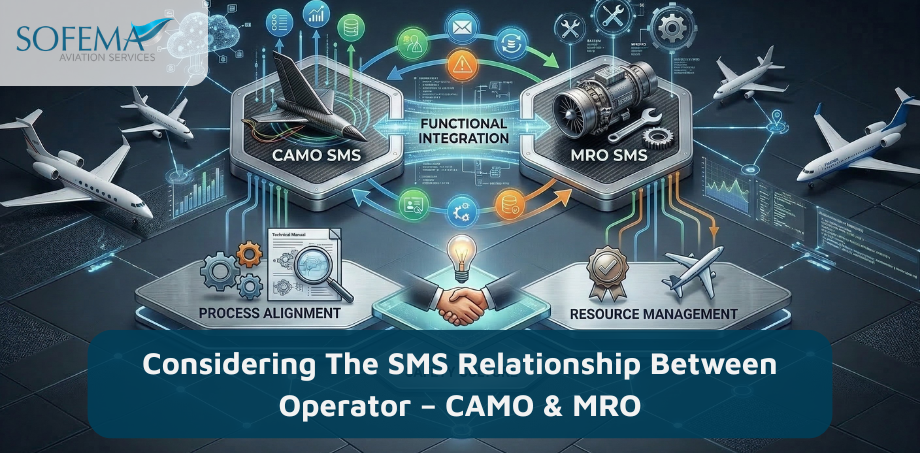
Sofema Aviation (SA) takes a deep dive into the relationship between Airline Operations (Part-ORO), Continuing Airworthiness (Part-CAMO), and Maintenance (Part-145)
Introduction
In 2026, SMS should no longer be a series of independent silos. Since the 2024 implementation deadline for Part-145 SMS, the regulatory expectation is a seamless, multidirectional flow of safety data.
Sitting between the Operator & Maintainer, the CAMO serves as the primary “data conduit,” engaging with both operational and maintenance risk assessments and managing the exposure as well as developing mitigations across all business processes.
Core Features of the Part-CAMO SMS
Under CAMO.A.200, the management system is expected to move beyond simple “compliance monitoring” (Quality) into active “risk management” (Safety). Key features include:
- Hazard Identification: This involves looking past the immediate technical defect to the underlying hazard.
- Safety Risk Management (SRM): This is the process of evaluating the impact of maintenance resource shortages, aging fleet issues, or environmental factors on the airline’s overall safety case.
- Safety Assurance: The CAMO should monitor Safety Performance Indicators (SPIs) that measure the actual health of the maintenance system.
Connecting the SMS: The CAMO-MRO Interface
Connecting a CAMO SMS to an MRO SMS requires functional integration that goes beyond the written contract. This is typically managed through several layers:
The Technical & Safety Agreement
The expected interface should be clearly defined in the CAME (Continuing Airworthiness Management Exposition) and the MOE (Maintenance Organisation Exposition). It establishes how issues and exposures in the hangar are understood throughout the SMS ecosystem and how the airline’s safety objectives are shared with the AMO.
Management of Change (MoC)
Ideally, a joint MoC will see the CAMO and the MRO sitting at the same table. The primary goal is to identify both potential exposures driven by potential changes as well as “latent conditions” (hazards that exist in the system but haven’t triggered an event yet).
- Gap Analysis of Procedures: CAMO & AMO internal procedures (CAME vs. MOE) will clearly differ. The MoC should identify where these differences create risk, such as how “Work Orders” are opened, how “Deferred Defects” are managed, or how “Complex Maintenance” is signed off.
- “Human Factors” When switching MROs, the new staff may be highly experienced but “new” to the specific operator’s fleet standards or specific modifications (STCs). The MoC should assess if the MRO’s training program and competence management processes covers adequately all potential exposures.
Deep Dive: The “Culture Clash” Challenge
A significant yet sometimes overlooked aspect concerns the misalignment of safety cultures.
- Production Pressure vs. Safety Margins: An MRO is often driven by “Turn Around Time” (TAT) and fixed-price contracts. If the Airline (CAMO) has a high-reliability safety culture but the MRO has a “get it out the door” culture, the friction will manifest as missed safety reports or rushed maintenance.
- Just Culture Alignment: The MoC should evaluate how the MRO handles errors. If the flow of safety data to the CAMO has the potential to dry up, then a best practice is to align the “Safety Policy” of both organizations during the MoC phase to ensure a shared understanding of “Just Culture.”
Managing New Aircraft Type Entry (EIS)
Adding a new type creates a massive systemic change.
- Technical Competency “Decay”: The MoC should address the risk of “Type Rating” validity versus “Recent Experience.” If the MRO hasn’t touched the new type in an extended period of time, then a risk mitigation step might be beneficial before the first heavy check.
- Software and Data Management: The MoC must evaluate the MRO’s capability to manage software loading, cybersecurity protocols, and digital logbook integrations. Failure in this area may constitute a continuing airworthiness hazard.
Common Shortfalls in the MoC Process
Experience from recent EASA findings suggests that MoCs often fail in the following ways:
- The “Static” MoC: The MoC is treated as a one-time document signed at the start of the contract. In reality, an MoC should be a “live” document that is reviewed periodically after the change to see if the predicted risks were accurate.
- Lack of Mitigation Evidence: An auditor will assess a risk (e.g., “Lack of specific engine tooling”) and verify the mitigation. If the mitigation should be real and evidence-based on planned future activities.
- Missing Financial/Commercial Context: While SMS is primarily about safety, the MoC process must account for commercial realities. If the contract is too thin, it creates a “hidden” safety hazard of resource cutting.
Best Practices:
- Joint Safety Review Board (SRB): hold periodic joint SRBs. This ensures that “early-onset” trends (like repeated errors in a specific task) are caught before they become systemic.
- Safety Liaison Presence: Ensuring a CAMO representative is on-site at the MRO serves as a safety mitigation, helping ensure the MRO’s SMS is functioning as expected.
Next Steps:
Join Sofema Aviation for a CAMO Compliance Challenges webinar on Tuesday, 24 March, from 10:30 – 13:00 Sofia time. Register for the webinar here – places are limited, so be sure to secure your spot early.
Explore our extensive course library featuring 500+ aviation training courses and take the opportunity to deepen your regulatory knowledge, or email [email protected] for support.
Tags:
CAMO webinar, SafetyManagementSystem, EASACompliance, AviationSafety, SafetyRiskManagement, Part145, AviationMaintenance, AviationCompliance, Sofema Aviation Serices (SAS), ContinuingAirworthiness, #AirworthinessManagement, PartCAMO, Sofema Aviation