
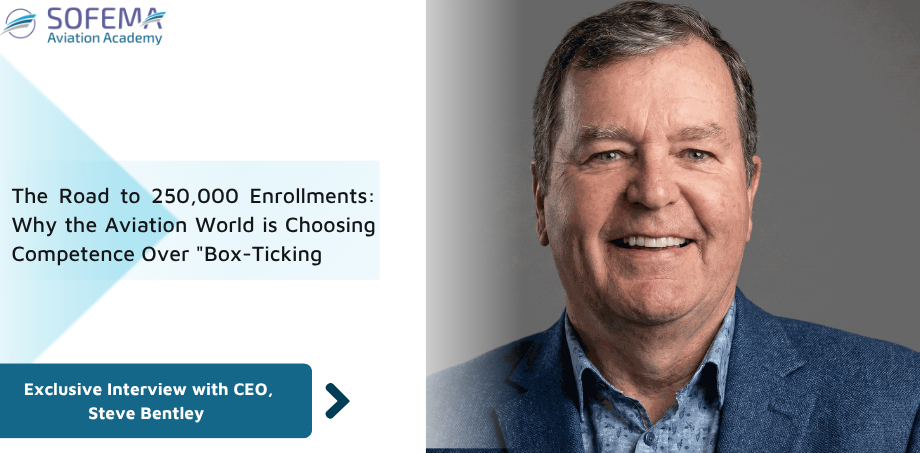
As Sofema Aviation Academy continues the journey toward 250,000 enrollments, the organization remains focused on a core principle: developing real operational competence rather than simply satisfying compliance requirements.
In this interview, Sofema CEO Steve Bentley shares insights into the philosophy, evolution, and future of aviation training in an industry where safety, performance, and regulatory agility are more critical than ever.
Part 1: The Philosophy of Beyond Compliance
Question: The title of this milestone journey contrasts competence with “box-ticking.” In an industry governed by strict legal frameworks, why do you believe traditional compliance training often falls into the trap of becoming an administrative hurdle rather than a capability builder?
Steve Bentley: It happens because many organizations view the regulator’s rulebook as the ceiling rather than the floor. In aviation, the regulations are simply the minimum acceptable standard to operate safely. When a company approaches training with a “box-ticking” mindset, the goal shifts from transfer of knowledge to risk mitigation against the next audit.
The auditor comes, sees a valid certificate, ticks the box, and leaves. But a certificate doesn’t fix an improperly rigged control cable in the hangar, nor does it identify a latent systemic flaw in a CAMO environment. Traditional training often fails because it focuses entirely on the text of the regulation rather than its intent and practical execution. We built Sofema to change that focus.
Question: You’ve noted that true safety and corporate agility live “beyond compliance.” How do you define that space, and what does a “beyond compliance” culture look like practically in a hangar or a CAMO office?
Steve Bentley: “Beyond compliance” is the space where an organization stops managing by administrative decree and starts managing by competence and risk mitigation. It’s a culture where people understand why a procedure exists, not just what the procedure says.
Practically, in a Part 145 hangar, a beyond-compliance culture means a technician doesn’t just sign off a task because the job card is complete; they actively look for overlapping risks or systemic waste (muda). In a CAMO office, it means management recognizes that real airworthiness is built on continuous monitoring and data-driven safety systems, not just maintaining an immaculate paper trail. It’s about systemic maturity.
Question: When Sofema sets out to design EASA-compliant material, how do your instructional designers ensure the content focuses on the “why and how” rather than just reciting the legal text?
Steve Bentley: We have a very strict rule at Sofema: we don’t hire theorists or career academics to write our courses. Our instructional material is developed by industry veterans, former Quality Managers, Part 145 Certifying Staff, and seasoned Auditors.
When we take a rigid EASA regulation, our developers split the screen. On one side is the legal text; on the other side is the real-world operational pressure. We ask ourselves: “What does this mean to an engineer at 2:00 AM on a freezing ramp when an aircraft is AOG (Aircraft on Ground)?” We explicitly design the material to bridge that gap, explaining the operational realities and safety logic behind the legal mandates.
Part 2: The Evolution from Classroom to Cloud
Question: Looking back to 2008, Sofema began as a traditional, face-to-face classroom provider. What was the exact tipping point that made you realize physical presence alone couldn’t sustain the industry’s training needs?
Steve Bentley: The tipping point was sheer physics and economics. In the early days, we were flying high-value instructors all over the globe to deliver 3-day or 5-day regulatory seminars. For the operators, this was incredibly inefficient. They weren’t just paying for the training; they were paying for flights, hotels, per diems, and, most damagingly, losing their key technical personnel from active duty for days at a time.
From a Lean perspective, that is pure waste. We realized that if we wanted to truly democratize high-quality aviation training and reach a global audience, we had to decouple our expertise from physical logistics. The cloud was the only logical progression.
Question: You’ve mentioned that the biggest hurdle in the digital leap was overcoming the industry-wide stigma of “click-through” online courses. What arguments or evidence finally convinced old-school aviation managers that digital learning could be just as rigorous as a three-day hotel seminar?
Steve Bentley: There was, and still is, a lot of garbage in the e-learning market where a user just hits “Next” fifty times and prints a certificate. To win over old-school Quality Managers, we had to prove our digital platform possessed undeniable depth.
We did this by ensuring our online courses matched our classroom syllabi page-for-page in technical rigor, backed by robust, randomized examination databases. Furthermore, we built an operational framework that stands up to scrutiny during official regulatory audits by National Aviation Authorities (NAAs). When a Quality Manager sees that our certificates are accepted by auditors worldwide because the underlying content is robust, the old “hotel seminar” argument completely falls apart.
Part 3: Capturing Regulatory Velocity
Question: The industry is experiencing what you term “regulatory velocity,” with rapid overhauls in frameworks like Part-IS, Part-CAMO, and SMS. How does Sofema structure its internal operations to act as “first responders” and update its digital catalog in lockstep with these changes?
Steve Bentley: It requires a highly agile corporate structure and zero bureaucratic bloat. The moment EASA issues an Opinion, an NPA (Notice of Proposed Amendment), or a final ED Decision, our regulatory monitoring team triggers an immediate review process.
Because we own our digital infrastructure and have a tight-knit network of active industry authors, we don’t have to wait through months of administrative red tape to push an update. We treat regulatory shifts like an operational dispatch. We update our material dynamically, ensuring our corporate clients are never left exposed to compliance gaps.
Question: When a major new regulation drops, aviation companies face the daunting task of training hundreds of employees instantly. From a business optimization standpoint, how does digital training protect an operator’s bottom line during these regulatory shifts?
Steve Bentley: Consider the logistics of training 500 engineers on a new mandate like Part-IS (Information Security) using traditional methods. Pulling them off the floor in batches completely disrupts production schedules, delays maintenance turn-times, and incurs immense overtime costs.
By shifting that burden to a 24/7 digital environment, the operator can transition their entire workforce smoothly through the regulatory update without a single minute of lost operational capacity. Employees learn at their own pace during natural operational lulls. It transforms a chaotic, expensive corporate fire drill into a controlled, measurable process.
Part 4: Scaling the Business Architecture
Question: Sofema successfully shifted its model from selling single, isolated courses to offering structured Job-Role Packages and Career-Path Diplomas. How did this evolution change your long-term relationship with individual professionals?
Steve Bentley: It shifted our role from a transaction-based vendor to a multi-year career partner. Historically, an engineer would come to us to buy a single course because they desperately needed to check a box for an upcoming audit.
By creating structured Diplomas – like our CAMO Digital Diploma or Quality & Safety Master Program – we mapped out clear vocational paths. Now, professionals utilize our platform over months and years to actively prepare for their next promotion or leadership role. It changed the dynamic entirely; they aren’t just looking backward at compliance, they are looking forward at career progression.
Question: The B2B Corporate Freedom Program has been a massive accelerator on the road to 250,000 enrollments. What specific operational freedoms or administrative reliefs does this bulk-access model give to an airline’s or MRO’s training department?
Steve Bentley: The Corporate Freedom Program is built entirely around removing administrative friction. In many large aviation organizations, the process of buying training is an absolute nightmare – raising purchase orders, waiting for budget approvals, and tracking individual invoices for every single employee. It’s a massive waste of administrative time.
With the Corporate Freedom Program, we give the company bulk, scalable access or an annual subscription. Their training managers can enroll hundreds of workers across various departments instantly at the click of a button. It eliminates the financial and bureaucratic hurdles, allowing training coordinators to focus entirely on workforce development rather than paperwork.
Part 5: The Horizon to 250,000 and Beyond
Question: As you look toward crossing the quarter-of-a-million enrollment mark in 2027, how has the profile or expectation of the typical aviation student evolved since you founded the company?
Steve Bentley: Today’s aviation professionals have a drastically lower tolerance for clunky, inefficient systems. They expect high-quality training to be fully mobile, immediately accessible, and completely flexible.
Furthermore, the new generation entering the workforce doesn’t just accept a rule because “it’s always been done that way.” They demand to know the operational context. They want to know the why. This shift perfectly aligns with our foundational approach, because we’ve always focused on building deep, practical competence rather than just serving up dry legal text.
Question: With technological breakthroughs and shifting global frameworks driving the industry faster than ever, what are the primary risks for aviation organizations that choose to “stand still” with their current training methods?
Steve Bentley: The primary risk is a creeping erosion of systemic safety and a complete loss of organizational agility. If your training methodologies remain static while the regulatory and technological landscape accelerates, a dangerous competence gap opens up within your workforce.
Organizations that stand still eventually suffer from higher error rates, increased audit findings, and a culture of complacency. In this industry, if you aren’t actively pushing your training maturity beyond the bare minimum compliance line, you are falling backward.
Question: Reaching 250,000 professionals is an incredible milestone, but it’s ultimately a stepping stone. What is the next frontier for Sofema Aviation in ensuring that competence remains the global standard for aviation training?
Steve Bentley: The next frontier is deeply embedding digital competence tracking into the wider corporate safety ecosystem. We want to move completely past the concept of the isolated training certificate.
Our focus is on helping organizations integrate training data directly into their Safety Management Systems (SMS) and Quality assurance frameworks. We will continue to scale our platform, harness data-driven insights, and pioneer flexible delivery methods, ensuring that wherever there is a hangar, a cockpit, or a management office, real operational capability remains the primary objective.
About Sofema Aviation Academy
Sofema Aviation Academy supports aviation professionals and organizations worldwide through specialized regulatory training and vocational development. Sofema Aviation provides access to more than 525+ aviation courses designed to build practical competence across airworthiness, safety, quality, operations, leadership, and compliance disciplines. Browse the courses here or contact the team at [email protected] for further information.
Tags:
EASA, MRO, Airworthiness, Interview, Steve Bentley FRAeS, AviationSafety, AviationTraining, AviationLeadership, SafetyManagement, ContinuousLearning, SA (Sofema Aviation), CompetenceDevelopment, BeyondCompliance