
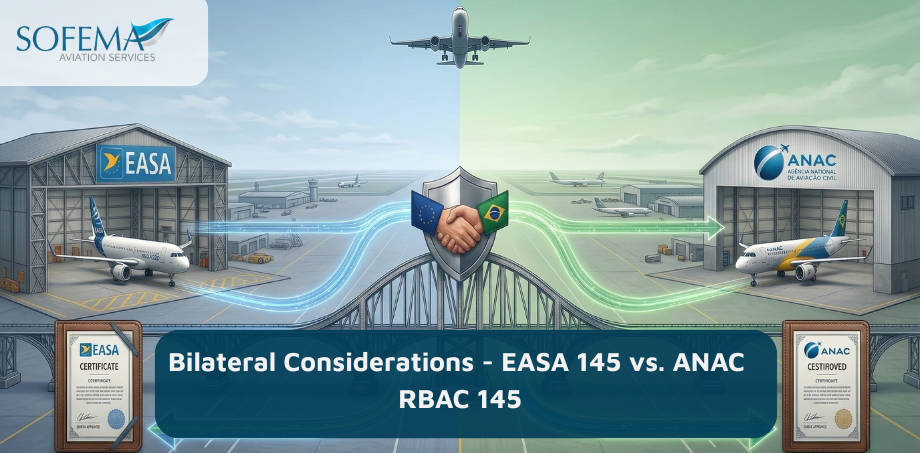
Sofema Aviation Services (SAS) looks at the key aspects of the EASA ANAC Bilateral related to 145
Introduction
The relationship between the European Union and Brazil is formalized through the EU-Brazil Bilateral Aviation Safety Agreement (BASA). It relies on two primary technical pillars: the Technical Implementation Procedures (TIP) for Design and Production (Initial Airworthiness) and the Maintenance Annex Guidance (MAG) for Continuing Airworthiness.
Continuing Airworthiness: Maintenance (MAG)
The MAG provides the specific instructions for organizations to hold dual approvals, namely EASA Part 145 and ANAC RBAC 145 (Regulamento Brasileiro da Aviação Civil).
Primary Oversight and Legal Basis
- EASA Part 145: Oversight is managed by the EU Member State’s National Aviation Authority (NAA) or EASA for foreign shops. The legal basis is Regulation (EU) No 1321/2014.
- ANAC RBAC 145: Oversight is managed by the National Civil Aviation Agency – Brazil (ANAC). The legal basis is the Brazilian Civil Aviation Regulations.
- Procedure: The MAG allows ANAC to perform oversight on behalf of EASA for Brazilian shops, and EASA/NAAs to perform oversight on behalf of ANAC for European shops. This eliminates the need for redundant audits by two different agencies.
The “Dual Release” Procedure
To release a component or aircraft across the border, the organization must be approved by both authorities.
- Release Document: EASA organizations use the EASA Form 1, while ANAC organizations use the ANAC Form F-100-01.
- Requirement: In Block 12 (Remarks), the certifying staff must include a specific statement of “Dual Release.” This statement must confirm that the work was performed in accordance with Part 145 and the ANAC special conditions, or vice versa, and must list both the EASA and ANAC approval numbers.
Quality and Safety Management (SMS)
Both authorities place a heavy emphasis on the Accountable Manager and Safety Management Systems (SMS).
- Procedure: Brazil was an early adopter of SMS (RBAC 121/145). With EASA’s recent transition to include SMS in Part 145 (Regulation 2021/1963), the safety requirements are now highly harmonized. Both systems require a robust internal audit program and a non-punitive safety reporting culture.
Key Differences and Technical “Special Conditions”
The “Special Conditions” are the specific “delta” requirements found in the MAG that an organization must meet to satisfy the foreign authority.
Maintenance Data and Major Repairs
A significant technical procedure involves approving data for repairs.
- Condition: Under the EASA-ANAC agreement, “Major” repairs or modifications must be approved by the Importing Authority (the authority of the State of Registry). A Brazilian AMO cannot use a “Major” repair approved only by ANAC on an EU-registered aircraft unless EASA has validated that data.
The Supplement Requirement
Every organization must maintain a specific “Supplement” to their manual (the MOE for EASA or the MPM for ANAC).
- ANAC Supplement (for EU Shops): Must include procedures for reporting unairworthy conditions to ANAC within 72 hours and ensuring that all parts used are documented correctly (e.g., FAA 8130-3 is only accepted under specific bilateral conditions).
- EASA Supplement (for Brazilian Shops): Must include procedures for using EASA-approved parts and ensuring that certifying staff meet the equivalent of EASA Part 66 training requirements for the specific tasks performed.
Personnel Licensing
- EASA: Relies on Part 66 licenses (B1, B2, C).
- ANAC: Relies on the CHT (Certificado de Habilitação Técnica) for mechanics.
- Procedure: The maintenance organization’s Quality Manager must verify that the certifying staff has sufficient experience and training to meet the “Special Conditions” of the other authority before granting them authorization to sign a Dual Release.
Next Steps
Sofema Aviation Services (SAS) and Sofema Online (SOL) provide classroom, webinar, and online training. Please see the websites or email [email protected].
Tags:
EASA, SAS blogs, AviationSafety, AviationTraining, AircraftMaintenance, AviationRegulations, SafetyManagementSystems, AviationCompliance, ContinuingAirworthiness, ANAC, EASAPart145