
Sofema Aviation Services (SAS) Takes a Deep Dive into the Management of Change Process.
Introduction
In the aviation industry, the Management of Change (MoC) is no longer optional; it is a mandatory component of the “Safety Risk Management” pillar within a Safety Management System (SMS).
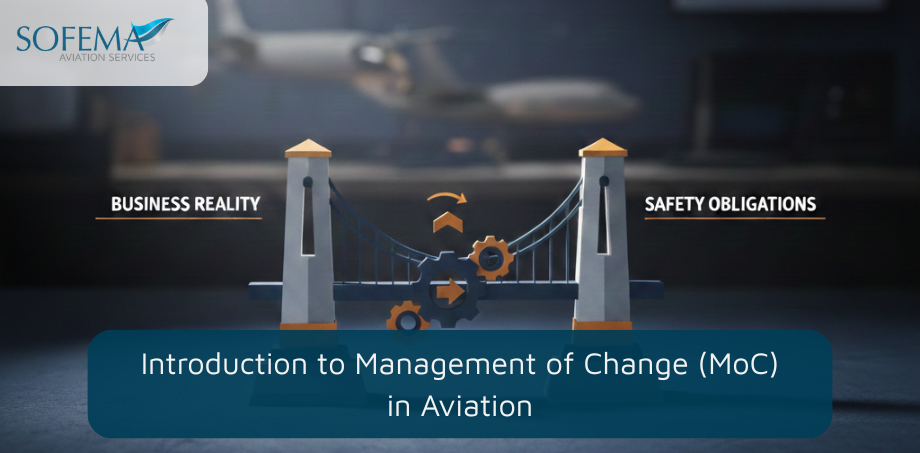
- EASA regulations explicitly acknowledge that business risks, such as financial pressure, commercial expansion, and restructuring, are frequently the root causes of safety risks. Consequently, the MoC process serves as the vital bridge between “Business Reality” and “Safety Obligations”.
The Link Between Business and Safety
A core principle of a mature SMS is managing the safety impact of business decisions.
- Economic factors, including budget cuts or contract changes, must be treated as distinct hazards with the same rigour as technical failures.
- When a change occurs, organizations must assess its impact on three specific pillars:
>> Resources (availability of staff and tools),
>> Management Direction (changes to policies or training), and
>> Management Control (supervision capabilities).
- Crucially, even if a business change seems minor, its potential impact on human performance must always be assessed.
A Structured, Proactive Process
Effective MoC is not a “box-ticking” exercise but a structured investigation into what could go wrong before a change is implemented.
- This process acts as a “circuit breaker,” forcing the organization to pause and ask if it is safe enough to proceed.
- A critical area of focus is the “Transition Period” means the interval between the old state and the fully implemented new state.
>> This phase is often where risk is highest due to hybrid procedures and potential confusion.
>> Therefore, risk assessments must define mitigating actions before the change goes live, rather than serving as retrospective justification.
Overcoming Cultural Challenges
Implementing MoC presents challenges, particularly the “tick-the-box” culture where forms are completed solely to satisfy auditors.
- This mentality focuses on compliance (“How do we get this approved?”) rather than operational effectiveness (“How do we make this safe?”).
- Furthermore, “siloed information” in medium-to-large organizations can hide hazards, as one department’s resource changes may inadvertently impact another.
- To combat resistance and “bureaucratic burden,” the MoC process must be scalable: while major changes require complex safety cases, simple changes should utilize simpler risk assessments.
- Ultimately, success depends on genuine management buy-in, ensuring that safety accountability is never outsourced, even when work is.
Next Steps
Sofema Aviation Services (SAS) and Sofema Online (SOL) Provide Classroom, and Online Training – Offering almost 1000 courses, packages, and diplomas compliant with EASA, FAA, UAE GCAA, Saudi GACA, UK CAA, and UK OTAR.
Tags:
SafetyRiskManagement, UK OTAR, Cultural Challenges, Management Direction, OperationalSafety, EASARegulations, AviationCompliance, AviationLeadership, HumanFactors, AviationTraining, EASA, AviationSafety, Management Control, Management of Change (MOC), UK CAA, UAE, FAA, GCAA, Safety Management System SMS