
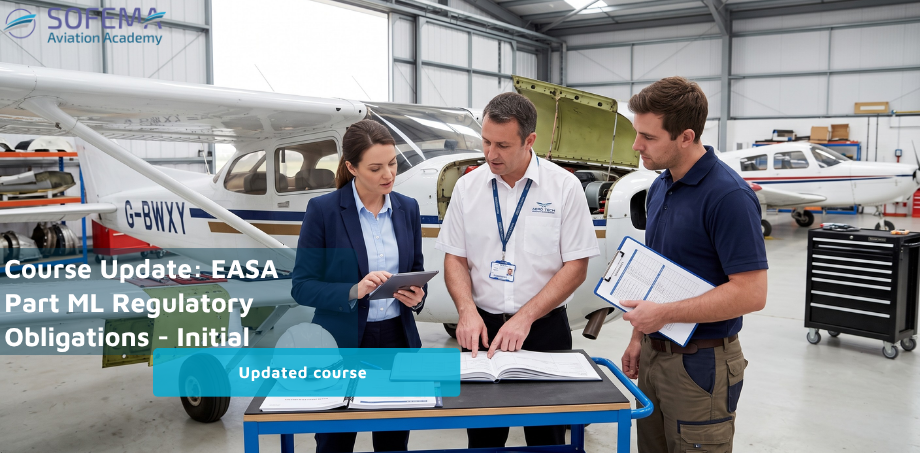
Sofema Aviation (SA) is excited to share the latest updated training:
EASA Part ML Regulatory Obligations – Initial
Understanding the New Era of Light Aircraft Continuing Airworthiness
The general aviation sector continues to evolve, and regulatory knowledge is becoming increasingly important for aircraft owners, operators, maintenance organisations, and continuing airworthiness professionals.
With the introduction of Commission Implementing Regulation (EU) 2026/100, EASA Part ML continues to provide a simplified, risk-based framework designed specifically for light aircraft. However, with greater flexibility comes increased responsibility – making a clear understanding of the regulation essential.
Sofema Aviation’s EASA Part ML Regulatory Obligations – Initial training provides a practical guide to understanding the requirements, responsibilities, and opportunities within the Part ML environment.
Course type: Presentation without voice-over
Duration: Equivalent to 1.5 days of classroom training
Price: 112.00 EUR
Which topics will be addressed?
1. Basic Introduction to EASA Regulations Part M & Part ML
2. Changes to EASA Part ML driven by Commission Implementing Regulation (EU) 2026/100
3. EASA Part ML Subpart A General
4. EASA Part ML Subpart B Accountability
5. EASA Part ML Subpart C Continuous Airworthiness
6. Subpart D Maintenance Standards
7. Subpart E Components
8. Subpart H Certificate of Release to Service (CRS)
9. Subpart I Airworthiness Review Certificate (ARC)
Why Part ML Knowledge Matters
While Part ML reduces administrative complexity, it also introduces important responsibilities for those managing aircraft continuing airworthiness.
Key Challenges in Implementing Part ML
Transitioning to or operating under Part ML, especially with the integration of Regulation (EU) 2026/100, comes with unique operational challenges:
The Responsibility Shift
Under Part ML, the owner can self-declare their Aircraft Maintenance Program (AMP) without direct NAA (National Aviation Authority) approval. While this reduces bureaucracy, it shifts the legal and safety onus entirely onto the owner/operator, who may lack technical regulatory expertise.
- Complex Pilot-Owner Boundaries: Misinterpreting what constitutes “limited pilot-owner maintenance” (Appendix II) vs. “complex maintenance” (Appendix III) can lead to illegal, uncertified maintenance.
- Adapting to 2026 Regulatory Changes: Aligning legacy maintenance practices with the newly implemented (EU) 2026/100 updates requires retraining staff and updating organizational manuals.
- Record-Keeping Diligence: Ensuring that continuing-airworthiness records (ML.A.305) are meticulously kept during aircraft transfers, preventing costly groundings or airworthiness gaps.
Best Practices for Success
To successfully navigate Part ML and maximize the efficiency of your fleet, organizations and owners should adopt the following best practices:
- Establish Robust AMP Reviews: Even if self-declaring an Aircraft Maintenance Program, engage a CAMO or a certified maintenance organization to perform an annual review of your AMP to ensure no critical manufacturer recommendations are missed.
- Implement Clear Pilot-Owner Logs: If utilizing Pilot-owner authorisation (ML.A.803), maintain a dedicated logbook section detailing exactly what tasks the pilot-owner is certified to do, backed by documented training.
- Leverage Structured Learning Paths: Do not rely on “the way we’ve always done it.” Enrolling your technical records, quality, and CAMO staff in Sofema Online’s structured General Aviation CAMO Learning Path Diploma ensures your entire organization operates with a synchronized, high-level understanding of EASA compliance.
- Standardize the Transfer Process: Create a pre-defined checklist based on ML.A.307 and ML.A.905 to streamline the transfer of records and registrations, mitigating the risk of missing documentation during aircraft sales or imports.
How to register?
Visit the course’s page here and enrol directly on Sofema Aviation or email [email protected] for group enrollments and support.
Tags:
CAMO, Airworthiness, AviationSafety, AviationTraining, AircraftMaintenance, AviationCompliance, ContinuingAirworthiness, SofemaAviation, EASAPartML, Part66