
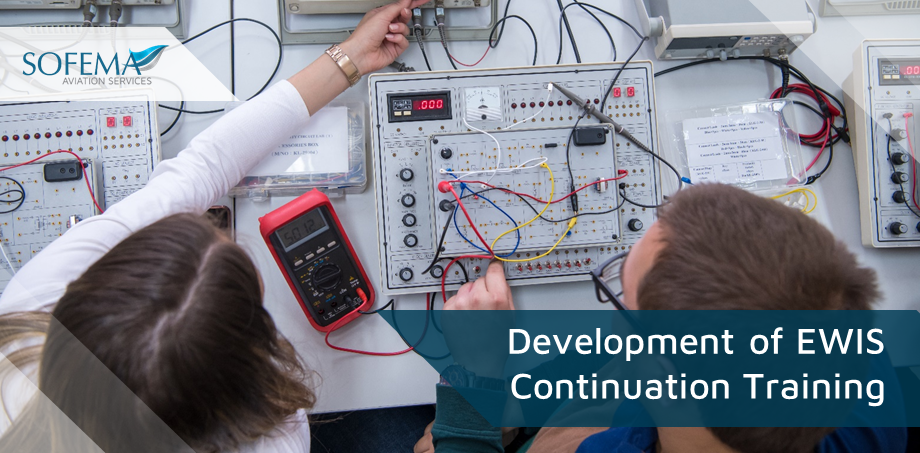
Sofema Aviation Services (SAS) looks at the challenge of EWIS Continuation Training
While initial training introduces EWIS principles, continuation training reinforces, updates, and deepens that knowledge, addresses evolving risks, and helps mitigate human factors associated with long-term maintenance activities.
Regulatory Basis for EWIS Continuation Training
Under EASA AMC 20-22, organizations approved under Part-145 and other relevant parts are required to ensure that personnel receive initial and continuation training appropriate to their assigned EWIS duties. This applies specifically to EWIS Groups 1 and 2 (Maintenance and Inspection personnel), but also to others as outlined in AMC 20-22 (Groups 3–8).
Key Regulatory References:
- AMC 145.A.30(e) – Personnel competence and training.
- AMC 20-22 – Guidelines for EWIS training program content.
- GM2 145.A.30(e) – Guidance on managing organizational competencies.
Continuation training should ensures:
- Reinforcement of correct practices.
- Awareness of new guidance, equipment, and techniques.
- Correction of deficiencies identified during audits or inspections.
Objectives of EWIS Continuation Training
The primary goals are:
- Reinforce understanding of EWIS safety, inspection techniques, and human factors.
- Update personnel on any regulatory changes, new tooling, materials, or standards.
- Address gaps identified during internal/external audits or incident reports.
- Support a safety culture that includes wiring awareness and proactive risk management.
- Integrate real-world experiences, case studies, and lessons learned into practical knowledge.
Content Considerations for Continuation Training
EWIS continuation training should be designed based on:
Risk-Based and Job-Specific Relevance
Focus on risks identified in the organization’s operational environment and tailor content to specific EWIS group roles. For example:
- Group 1 (Maintenance): Update on tooling, crimping standards, and routing practices.
- Group 2 (Inspection): Refresher on DET vs GVI techniques, documentation interpretation.
Incident and Audit Findings
Training should include analysis of real or simulated internal events, such as:
- Misrouted wiring.
- Missed contamination.
- Improper clamp usage. This reinforces corrective actions and prevents repeat occurrences.
New Technologies and Techniques
Introduce and demonstrate new materials, connectors, or inspection tools where applicable.
Regulatory Updates
Incorporate updates to AMC 20-21, AMC 20-22, CS-25 Appendix H, or FAA AC 25.1701–25.1709 if applicable.
Human Factors and Safety Culture
Highlight EWIS-related human error trends and mitigation strategies. Emphasize speak-up culture and reporting of wiring issues or unsafe practices.
Instructional Design Best Practices
EWIS continuation training should go beyond “tick-the-box” presentations. It should be designed using principles of adult learning and competency-based training.
Interactive and Practical Delivery
- Use visual aids, wiring samples, or photos of real defects.
- Include quizzes, spot-the-error activities, and small-group discussions.
- Allow feedback sharing to connect learning with operational experience.
Use of Case Studies
Examples like Swissair Flight 111, BA G-DOCE, or MD-11 smoke and fire events effectively demonstrate the real-world consequences of wiring issues.
Modular Approach
Create short, focused modules (20–45 minutes each), covering:
- Inspection integrity
- Connector and termination reliability
- Routing and separation challenges
- Inspection fatigue and complacency over time
Assessment and Competence Validation
While formal exams may not always be required, practical observation, feedback, and knowledge checks should be included to validate comprehension.
Trainer Requirements
Trainers delivering EWIS continuation must:
- Have current technical knowledge of EWIS and be familiar with regulatory developments.
- Be skilled in instructional techniques to ensure message retention.
- Understand the organization’s EWIS procedures, tooling, and maintenance practices.
Common Mistakes to Avoid
- Using outdated material or not reflecting updated wiring practices.
- Focusing only on theory, without practical or scenario-based engagement.
- Treating continuation training as a box-ticking exercise, without competence reinforcement.
- Neglecting low-frequency but high-impact risks such as fuel tank wiring zones.
Next Steps
Follow this link to our Library to find & download related documents for Free.
Sofema Aviation Services (SAS) offers EWIS Training as an extension to our Continuing Airworthiness Instructor Training Program.
Train The Trainer Electrical Wiring Interconnect System (EWIS) – 2 Days
Tags:
EWIS, Human Factors, Part 145, AMC 20-22, SAS blogs, Inspection Techniques, regulatory changes, Case Studies, EASA AMC 20-22, AMC 145.A.30(e), GM2 145.A.30(e), real-world experiences, wiring awareness, proactive risk management, DET vs GVI, FAA AC 25.1701–25.1709