
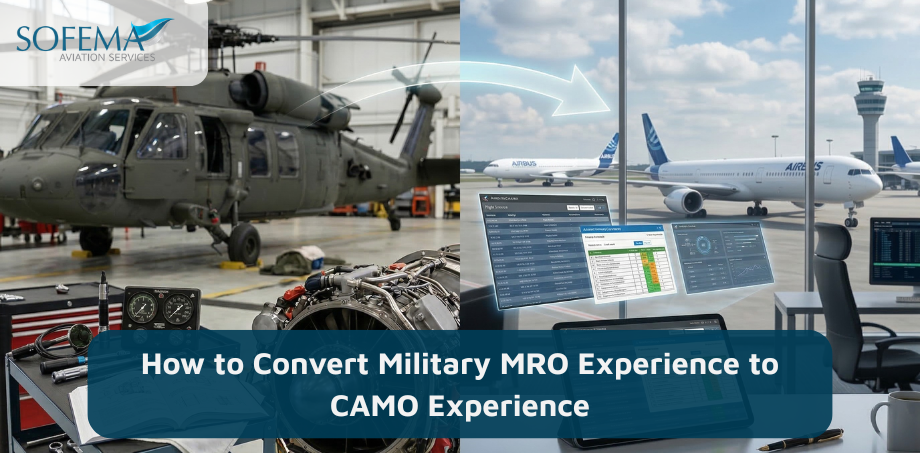
Sofema Aviation looks at the transition process from Military to Civilian CAMO.
Introduction
Transitioning from a military aviation background – specifically one rooted in EMAR (European Military Airworthiness Requirements) – to a civilian EASA Part CAMO (Continuing Airworthiness Management Organisation) environment is a natural progression. Because EMAR was designed to mirror EASA regulations, the technical “language” remains consistent, though the commercial application differs significantly.
Key Challenges of the Transition
While your engineering expertise is a direct match, the “Civilian Mindset” shift involves several hurdles:
- Commercial vs. Operational Priority: In the military, “Mission Accomplishment” can sometimes justify expedited processes.
- In a civilian CAMO, the Certificate of Airworthiness (CofA) is the ultimate authority. If the documentation isn’t perfect, the aircraft does not fly – regardless of the commercial cost of a grounded plane.
- The “Just Culture” in SMS: EASA Part CAMO places a massive emphasis on a Safety Management System (SMS).
- This requires a shift from a traditional hierarchical command structure to a collaborative, risk-based reporting environment where “human factors” are analyzed over “blame.”
- Licensing Gaps: Military trade certificates do not always translate 1:1 to an EASA Part 66 License. While CAMO roles are office-based, higher-level technical positions often require a “C” license or at least a deep understanding of the Part 66 categories to manage maintenance effectively.
- Data Integrity & Software: Civilian CAMOs use sophisticated MIS (Management Information Systems) such as AMOS or Envision. Military personnel may find the civilian focus on “digital birth certificates” for life-limited parts to be more granular than military record-keeping.
Best Action Steps
To move into a Part CAMO role efficiently, follow these steps:
- Regulatory Certification: Ensure you have a current certificate in EASA Part M & Part CAMO (Regulation (EU) 1321/2014) and Human Factors. (Also Fuel Tank Safety & EWIS) Most civilian employers view these as non-negotiable prerequisites.
- Translate Your Experience: Remove military acronyms from your CV. Instead of “Flight Line NCOIC,” use “Line Maintenance Coordinator.” Highlight your experience with AMP (Aircraft Maintenance Programmes) and AD/SB (Airworthiness Directive/Service Bulletin) assessment.
Typical Transition Timeline
- Preparation (6 Months prior to exit): Research the specific civilian aircraft types you want to work with (e.g., Boeing 737, Airbus A320) and begin networking on platforms like LinkedIn.
- Training Phase (2-4 Months prior to exit): Complete your initial regulatory training.
- Application Phase (Last 3 Months): Start applying for roles. Military veterans are often highly sought after for their reliability and systematic approach to safety.
Initial 6 months in your New Role
- Technical Records (The Foundation): You will likely start by “clearing” flight logs. This isn’t just data entry; it’s a forensic audit. You will be checking that a component swapped on a Friday night in a different country has a valid EASA Form 1, that the serial numbers match exactly, and that the “Next Due” figures were calculated correctly.
- Maintenance Planning (The Strategy): You may move into creating work packages or managing the Aircraft Maintenance Programme (AMP). In a civilian CAMO, the AMP is a living document. You will learn how to “escalate” or “de-escalate” tasks based on reliability data—a critical skill for any future ARS.
Bridging the “Culture Gap”
The first six months are less about engineering and more about Regulation (EU) 1321/2014.
- Understanding the CAME: Every CAMO operates under a Continuing Airworthiness Management Exposition (CAME). This is your new “Standing Orders.” Your onboarding will involve memorizing how your specific company interfaces with the National Aviation Authority
- The Just Culture Shift: You will experience your first civilian Safety Report. Unlike the military, where an error might lead to a formal “Summary Hearing,” the civilian CAMO should use these 6 months to train you on Root Cause Analysis (RCA). You’ll learn how to fix the system, not just reprimand the person.
Available Positions for the Right Candidate
For someone with an EMAR background, these roles are the best fit:
- Maintenance Planner: Scheduling hangar visits and line maintenance based on the Aircraft Maintenance Programme.
- Technical Records Specialist: Managing the “life” of the aircraft by ensuring every component has a valid EASA Form 1.
- Reliability Engineer: Using data to identify if certain parts are failing prematurely and adjusting the maintenance schedule accordingly.
- Technical Services/Powerplant Engineer: Managing complex engine health monitoring or major structural repairs.
- Compliance Monitoring Auditor: A high-level role ensuring the CAMO follows all EASA regulations – perfect for those with a military “Quality Assurance” background.
Next Steps
Join Sofema Aviation for a CAMO Compliance Challenges webinar on Tuesday, 24 March, from 10:30 – 13:00 Sofia time. Register for the webinar here – places are limited, so be sure to secure your spot early.
Explore our extensive course library featuring 500+ aviation training courses and take the opportunity to deepen your regulatory knowledge, or email [email protected] for support.
Sofema Aviation Services (SAS) and Sofema Online (SOL) provide classroom, webinar, and online training. Please see the websites or email [email protected] for support.
Tags:
CAMO, EASA, Airworthiness, webinar, EMAR, AviationTraining, AircraftMaintenance, AviationCareers, AviationCompliance, SafetyManagement, ContinuingAirworthiness, Sofema Aviation (SAS)