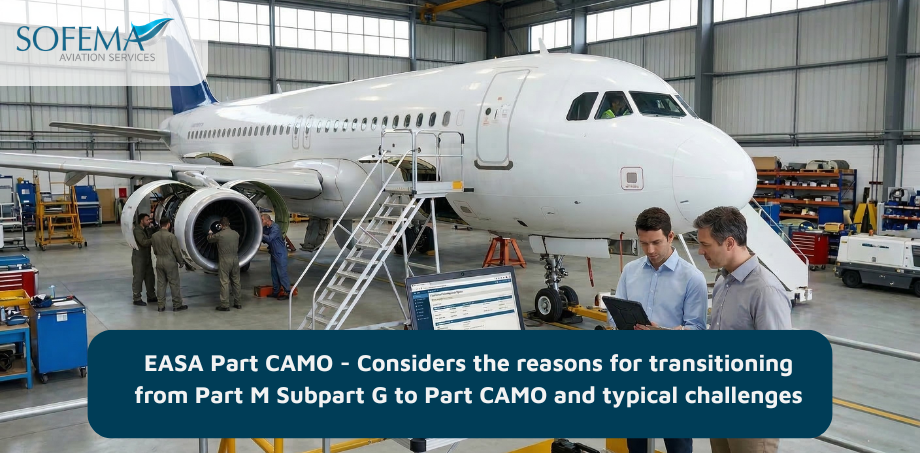
Sofema Aviation considers the transition from Part M Subpart G to EASA Part CAMO
Why the Transition Happened
The primary reason for moving from Part M Subpart G to Part-CAMO was to bridge a safety gap. EASA wanted to ensure that a Continuing Airworthiness Management Organization (CAMO) had a consistent view with both Operations and Maintenance
By mandating a Safety Management System (SMS), the regulator ensured that airworthiness is managed with the same rigor as flight operations.
- Proactive vs. Reactive: Subpart G was largely reactive – you found a mistake during a quality audit and fixed it. Part-CAMO is proactive; it requires the organization to look for “latent conditions” (like high staff turnover or poor software interfaces) before they lead to an unairworthy aircraft.
- Human Performance: Part-CAMO officially recognizes that humans manage airworthiness. It introduces mandatory Human Factors training and considerations, acknowledging that fatigue, stress, and communication breakdowns happen in the office just as often as they do on the tarmac.
The Challenges of Transition
The “upgrade” to Part-CAMO brought several friction points for organizations, mostly centered around the increased administrative and cultural burden.
The Safety Management Burden
For many smaller CAMOs, the requirement to establish a full SMS was considerable. Under Subpart G, you only needed a Quality Manager. Now, you need a Compliance Manager, a Safety Manager ( the roles may be combined) and a defined Safety Policy.
Finding qualified personnel who understand risk data analysis – rather than just technical maintenance, became a significant recruitment challenge.
Documenting the “CAME”
The Continuing Airworthiness Management Exposition (CAME) had to be updated. It wasn’t just a matter of changing “Subpart G” to “Part-CAMO.” Organizations had to document brand-new processes for:
- Hazard identification and risk assessment.
- Safety reporting and internal investigations.
- Management of Change (evaluating risks before moving offices, changing software, or hiring new teams).
The Competency Assessment Gap
Part-CAMO increased the focus on the management of competence. The expectation is that the organization must now assess and record the actual competence of every person involved in the management system.
Transitioning the “Quality” Mindset
One of the most difficult challenge was the shift from Quality Assurance (QA) to Compliance Monitoring. In the old days, the Quality Manager was the “policeman.” In Part-CAMO, the Compliance Monitoring Manager ensures the rules are followed, but the entire management team is responsible for safety. Breaking the habit of “that’s the Quality Department’s problem” has been a long, uphill battle for many legacy operators.
Management of Change (MoC)
Under the legacy Part M Subpart G, changes were often handled reactively or viewed as simple administrative updates to the manual. Part CAMO mandates a proactive approach where risks must be assessed before a change occurs.
- Pre-Implementation Risk Assessment: Organizations are now required to evaluate the potential safety impact of organizational changes-such as moving offices, implementing new software, or hiring new teams-before they are finalized.
- Focus on Latent Conditions: The management of change must specifically look for hidden risks, such as high staff turnover or poor communication interfaces, that could eventually lead to an unairworthy aircraft.
- Documentation in the CAME: The Continuing Airworthiness Management Exposition (CAME) must be rewritten to include formal procedures for how these changes are evaluated, approved, and monitored.
Internal and External Incident Reporting
The transition moves the organization away from a “policeman” style of quality auditing toward a comprehensive Safety Management System (SMS).
- From “Mistakes” to “Hazards”: While Subpart G focused on fixing mistakes found during audits, Part CAMO requires reporting of “hazards.” This means staff must report potential risks before an incident even happens.
- Internal Investigations: The reporting system now includes internal investigations into “why” a process failed, moving beyond just technical defects to address human performance issues like fatigue, stress, and communication breakdowns.
- Safety Reporting Infrastructure: Organizations must establish a defined Safety Policy and clear channels for staff to report concerns without fear of retribution, fostering a “just culture.”
Key Transition Challenges
The move to Part CAMO isn’t just a name change; it represents a significant increase in administrative and personnel requirements.
- The Competency Assessment Gap: Organizations must now move beyond simple training records and actively assess and record the actual competence of every person involved in the management system.
- The Compliance vs. Quality Shift: A major hurdle is breaking the “legacy” mindset where safety was the “Quality Department’s problem.” In the new framework, the Compliance Monitoring Manager ensures rules are met, but the entire management team is responsible for the safety data.
- Recruitment and Personnel: Finding staff who understand risk data analysis—rather than just technical maintenance—has become a primary challenge for smaller CAMOs.
- The Burden of SMS: For many, the transition requires hiring or designating a dedicated Safety Manager and a Compliance Manager, roles that require a different skillset than the traditional Quality Manager.
Next Steps
Join Sofema Aviation for a CAMO Compliance Challenges webinar on Tuesday, 24 March, from 10:30 – 13:00 Sofia time. Register for the webinar here – places are limited, so be sure to secure your spot early.
Explore our extensive course library featuring 500+ aviation training courses and take the opportunity to deepen your regulatory knowledge, or email [email protected] for support.
Sofema Aviation Services (SAS) and Sofema Online (SOL) provide classroom, webinar, and online training. Please see the websites or
Tags:
EASA, Safety Management System SMS, continuing airworthiness, Part CAMO, sasblogs, Part M Subpart G, Sofema Online (SOL), sofema aviations (SAS)